logo

EbookBell.com

Most ebook files are in PDF format, so you can easily read them using various software such as Foxit Reader or directly on the Google Chrome browser.
Some ebook files are released by publishers in other formats such as .awz, .mobi, .epub, .fb2, etc. You may need to install specific software to read these formats on mobile/PC, such as Calibre.

Please read the tutorial at this link:  https://ebookbell.com/faq 


We offer FREE conversion to the popular formats you request; however, this may take some time. Therefore, right after payment, please email us, and we will try to provide the service as quickly as possible.


For some exceptional file formats or broken links (if any), please refrain from opening any disputes. Instead, email us first, and we will try to assist within a maximum of 6 hours.

EbookBell Team
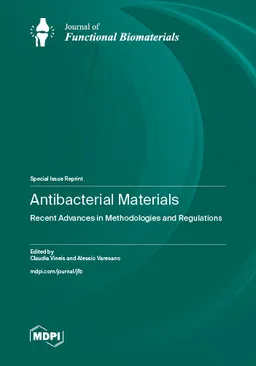
Antibacterial Materials Recent Advances In Methodologies And Regulations Claudia Vineis

  • SKU: BELL-236911108
Antibacterial Materials Recent Advances In Methodologies And Regulations Claudia Vineis
$ 35.00 $ 45.00 (-22%)

4.1

60 reviews

Antibacterial Materials Recent Advances In Methodologies And Regulations Claudia Vineis instant download after payment.

Publisher: MDPI
File Extension: PDF
File size: 33.77 MB
Pages: 276
Author: Claudia Vineis, Alessio Varesano
ISBN: 9783725841783, 9783725841776, 3725841780, 3725841772
Language: English
Year: 2025

Product desciption

Antibacterial Materials Recent Advances In Methodologies And Regulations Claudia Vineis by Claudia Vineis, Alessio Varesano 9783725841783, 9783725841776, 3725841780, 3725841772 instant download after payment.

In recent years, the emergence of resistant bacteria has stimulated intensive research in developing antibacterial materials in different fields in order to reduce the spread of antibiotic-resistant bacterial strains. Novel antibacterial materials include a large number of compounds such as nanoparticles, polymers, chemicals, proteins, and enzymes. 
-
Moreover, the final antibacterial products that embed the antibacterial compound can have many different shapes, such as textiles, plastics, cosmetics, ceramics, metals, paper, wood, etc. It is difficult to compare the performances of such different materials and applications because cross-method comparisons are currently lacking in the literature. Moreover, the procedures for testing developed in the past are often unsuitable for new antibacterial materials/products, and the scientific soundness of the results can be weak.
-
Quantification (e.g., bacterial reduction) is crucial, and qualitative-only methods can be misleading. The conditions for testing required by current regulations should be critically evaluated to assess the limits of their applications. On the other hand, existing procedures for antibacterial testing of materials are usually quite far from real conditions. Simple and affordable methods have to be developed in order to ensure reproducibility and robustness in conditions close to real world. The aim of this Special Issue is to stimulate contributions to fill these gaps.

Related Products