Most ebook files are in PDF format, so you can easily read them using various software such as Foxit Reader or directly on the Google Chrome browser.
Some ebook files are released by publishers in other formats such as .awz, .mobi, .epub, .fb2, etc. You may need to install specific software to read these formats on mobile/PC, such as Calibre.
Please read the tutorial at this link: https://ebookbell.com/faq
We offer FREE conversion to the popular formats you request; however, this may take some time. Therefore, right after payment, please email us, and we will try to provide the service as quickly as possible.
For some exceptional file formats or broken links (if any), please refrain from opening any disputes. Instead, email us first, and we will try to assist within a maximum of 6 hours.
EbookBell Team
5.0
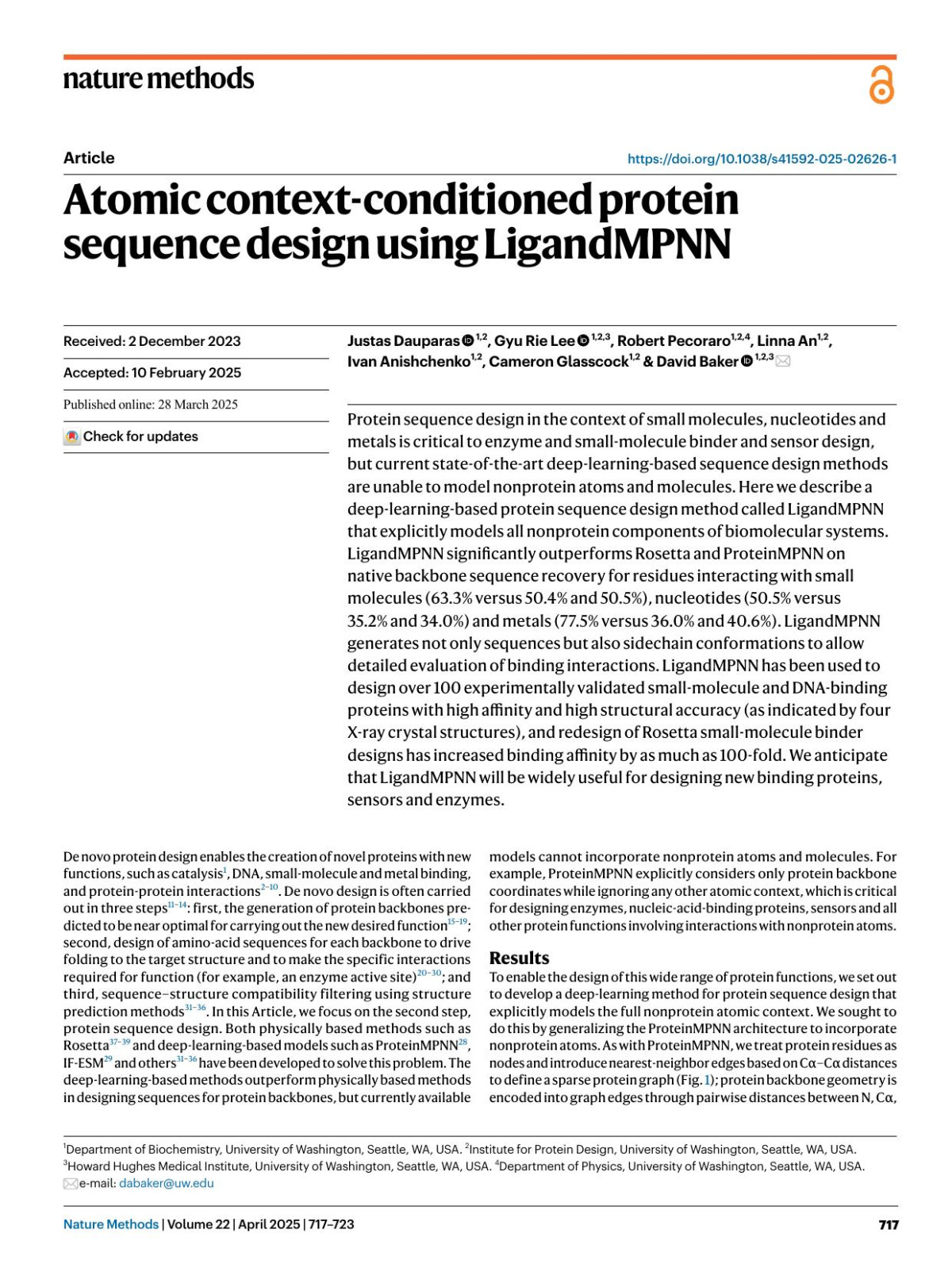
18 reviewsProtein sequence design in the context of small molecules, nucleotides and metals is critical to enzyme and small-molecule binder and sensor design, but current state-of-the-art deep-learning-based sequence design methods are unable to model nonprotein atoms and molecules. Here we describe a deep-learning-based protein sequence design method called LigandMPNN that explicitly models all nonprotein components of biomolecular systems. LigandMPNN signifcantly outperforms Rosetta and ProteinMPNN on native backbone sequence recovery for residues interacting with small molecules (63.3% versus 50.4% and 50.5%), nucleotides (50.5% versus 35.2% and 34.0%) and metals (77.5% versus 36.0% and 40.6%). LigandMPNN generates not only sequences but also sidechain conformations to allow detailed evaluation of binding interactions. LigandMPNN has been used to design over 100 experimentally validated small-molecule and DNA-binding proteins with high afnity and high structural accuracy (as indicated by four X-ray crystal structures), and redesign of Rosetta small-molecule binder designs has increased binding afnity by as much as 100-fold. We anticipate that LigandMPNN will be widely useful for designing new binding proteins, sensors and enzymes.