logo

EbookBell.com

Most ebook files are in PDF format, so you can easily read them using various software such as Foxit Reader or directly on the Google Chrome browser.
Some ebook files are released by publishers in other formats such as .awz, .mobi, .epub, .fb2, etc. You may need to install specific software to read these formats on mobile/PC, such as Calibre.

Please read the tutorial at this link:  https://ebookbell.com/faq 


We offer FREE conversion to the popular formats you request; however, this may take some time. Therefore, right after payment, please email us, and we will try to provide the service as quickly as possible.


For some exceptional file formats or broken links (if any), please refrain from opening any disputes. Instead, email us first, and we will try to assist within a maximum of 6 hours.

EbookBell Team
Braincomputer Interface Training For Multimodal Functional Recovery In Patients With Brain Injury A Case Series Peili Cao

  • SKU: BELL-239631974
Braincomputer Interface Training For Multimodal Functional Recovery In Patients With Brain Injury A Case Series Peili Cao
$ 35.00 $ 45.00 (-22%)

4.7

96 reviews

Braincomputer Interface Training For Multimodal Functional Recovery In Patients With Brain Injury A Case Series Peili Cao instant download after payment.

Publisher: x
File Extension: PDF
File size: 3.63 MB
Pages: 17
Author: Peili Cao, Shijie Guo, Gangli Zhang, Xiang Zan, Junhao Wang, Fulong Zhang, Javier Muñoz, Brandon Lucke-Wold, Rui Cheng
ISBN: 10.21037/QIMS-2025-1136
Language: English
Year: 2025

Product desciption

Braincomputer Interface Training For Multimodal Functional Recovery In Patients With Brain Injury A Case Series Peili Cao by Peili Cao, Shijie Guo, Gangli Zhang, Xiang Zan, Junhao Wang, Fulong Zhang, Javier Muñoz, Brandon Lucke-wold, Rui Cheng 10.21037/QIMS-2025-1136 instant download after payment.

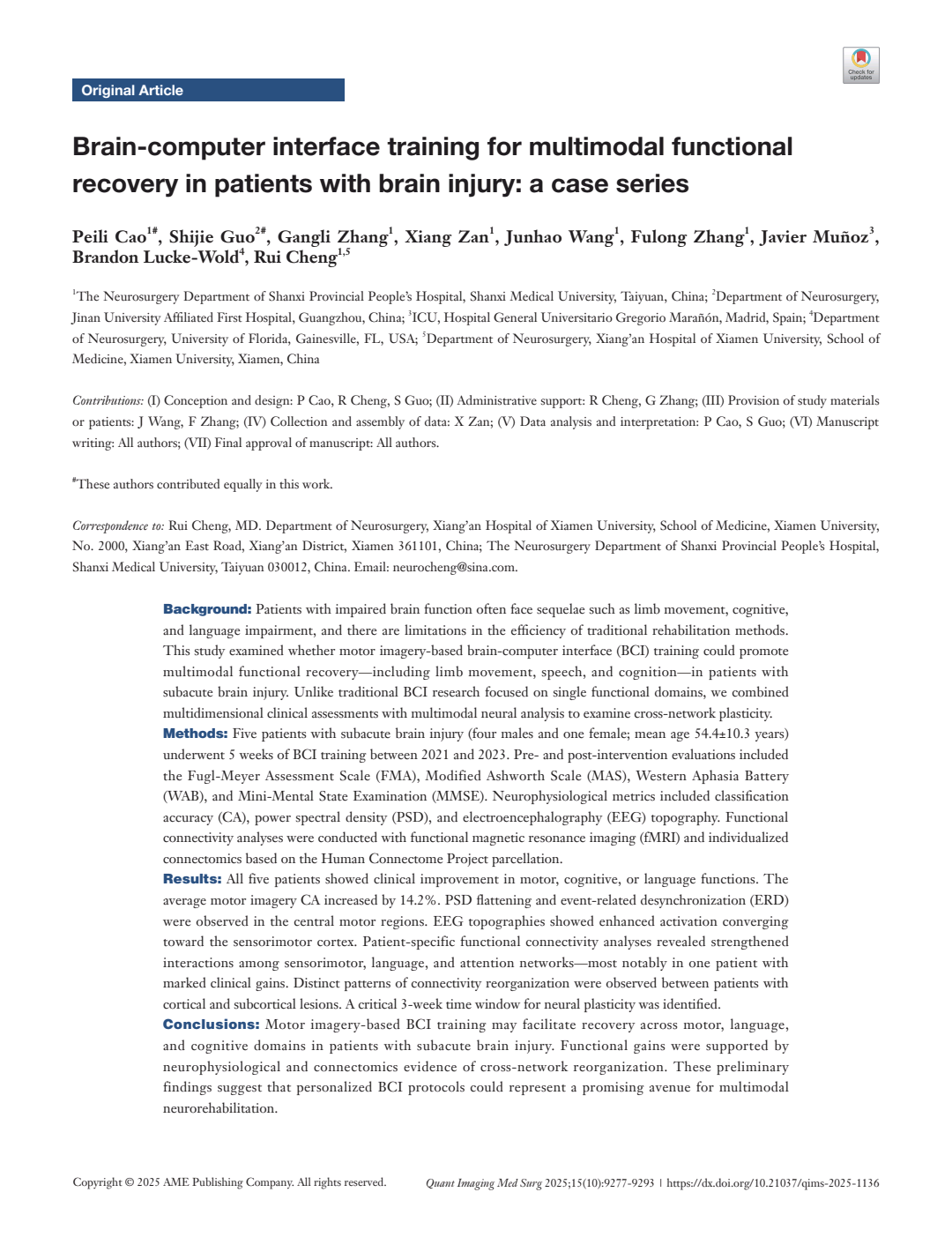
Patients with impaired brain function often face sequelae such as limb movement, cognitive, and language impairment, and there are limitations in the efficiency of traditional rehabilitation methods. This study examined whether motor imagery-based brain-computer interface (BCI) training could promote multimodal functional recovery—including limb movement, speech, and cognition—in patients with subacute brain injury. Unlike traditional BCI research focused on single functional domains, we combined multidimensional clinical assessments with multimodal neural analysis to examine cross-network plasticity. 
-
Five patients with subacute brain injury (four males and one female; mean age 54.4±10.3 years) underwent 5 weeks of BCI training between 2021 and 2023. Pre- and post-intervention evaluations included the Fugl-Meyer Assessment Scale (FMA), Modified Ashworth Scale (MAS), Western Aphasia Battery (WAB), and Mini-Mental State Examination (MMSE). Neurophysiological metrics included classification accuracy (CA), power spectral density (PSD), and electroencephalography (EEG) topography. Functional connectivity analyses were conducted with functional magnetic resonance imaging (fMRI) and individualized connectomics based on the Human Connectome Project parcellation.Results: All five patients showed clinical improvement in motor, cognitive, or language functions. The average motor imagery CA increased by 14.2%.
-
PSD flattening and event-related desynchronization (ERD) were observed in the central motor regions. EEG topographies showed enhanced activation converging toward the sensorimotor cortex. Patient-specific functional connectivity analyses revealed strengthened interactions among sensorimotor, language, and attention networks—most notably in one patient with marked clinical gains. Distinct patterns of connectivity reorganization were observed between patients with cortical and subcortical lesions.

Related Products