logo

EbookBell.com

Most ebook files are in PDF format, so you can easily read them using various software such as Foxit Reader or directly on the Google Chrome browser.
Some ebook files are released by publishers in other formats such as .awz, .mobi, .epub, .fb2, etc. You may need to install specific software to read these formats on mobile/PC, such as Calibre.

Please read the tutorial at this link:  https://ebookbell.com/faq 


We offer FREE conversion to the popular formats you request; however, this may take some time. Therefore, right after payment, please email us, and we will try to provide the service as quickly as possible.


For some exceptional file formats or broken links (if any), please refrain from opening any disputes. Instead, email us first, and we will try to assist within a maximum of 6 hours.

EbookBell Team
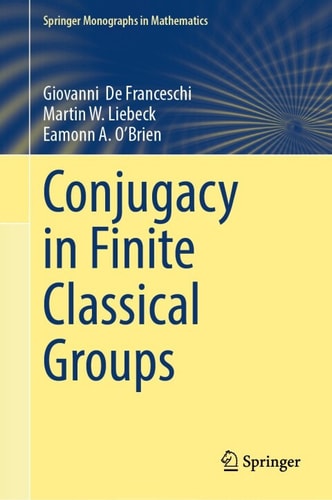
Conjugacy In Finite Classical Groups Giovanni De Franceschi Martin W Liebeck

  • SKU: BELL-237459600
Conjugacy In Finite Classical Groups Giovanni De Franceschi Martin W Liebeck
$ 35.00 $ 45.00 (-22%)

0.0

0 reviews

Conjugacy In Finite Classical Groups Giovanni De Franceschi Martin W Liebeck instant download after payment.

Publisher: x
File Extension: PDF
File size: 4.88 MB
Pages: 179
Author: Giovanni De Franceschi, Martin W. Liebeck, Eamonn A. O'Brien
ISBN: 9783031864612, 9783031864605, 3031864611, 3031864603
Language: English
Year: 2025

Product desciption

Conjugacy In Finite Classical Groups Giovanni De Franceschi Martin W Liebeck by Giovanni De Franceschi, Martin W. Liebeck, Eamonn A. O'brien 9783031864612, 9783031864605, 3031864611, 3031864603 instant download after payment.

This book provides a comprehensive coverage of the theory of conjugacy in finite classical groups. Given such a classical group G, the three fundamental problems considered are the following: to list a representative for each conjugacy class of G; to describe the centralizer of each representative, by giving its group structure and a generating set; and to solve the conjugacy problem in G—namely, given two elements of G, establish whether they are conjugate, and if so, find a conjugating element. The book presents comprehensive theoretical solutions to all three problems, and uses these solutions to formulate practical algorithms. In parallel to the theoretical work, implementations of these algorithms have been developed in Magma. These form a critical component of various general algorithms in computational group theory—for example, computing character tables and solving conjugacy problems in arbitrary finite groups.

Related Products