logo

EbookBell.com

Most ebook files are in PDF format, so you can easily read them using various software such as Foxit Reader or directly on the Google Chrome browser.
Some ebook files are released by publishers in other formats such as .awz, .mobi, .epub, .fb2, etc. You may need to install specific software to read these formats on mobile/PC, such as Calibre.

Please read the tutorial at this link:  https://ebookbell.com/faq 


We offer FREE conversion to the popular formats you request; however, this may take some time. Therefore, right after payment, please email us, and we will try to provide the service as quickly as possible.


For some exceptional file formats or broken links (if any), please refrain from opening any disputes. Instead, email us first, and we will try to assist within a maximum of 6 hours.

EbookBell Team
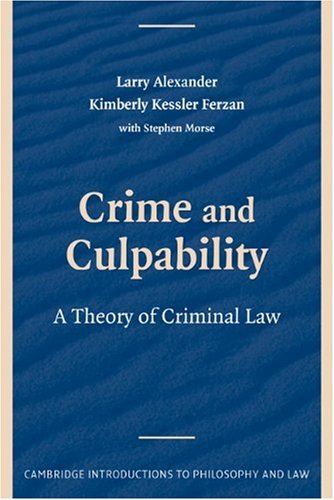
Crime And Culpability A Theory Of Criminal Law 1st Edition Larry Alexander

  • SKU: BELL-1295652
Crime And Culpability A Theory Of Criminal Law 1st Edition Larry Alexander
$ 35.00 $ 45.00 (-22%)

4.8

34 reviews

Crime And Culpability A Theory Of Criminal Law 1st Edition Larry Alexander instant download after payment.

Publisher: Cambridge University Press
File Extension: PDF
File size: 2.51 MB
Pages: 374
Author: Larry Alexander, Kimberly Kessler Ferzan, Stephen J. Morse
ISBN: 9780521518772, 9780521739610, 0521518776, 0521739616
Language: English
Year: 2009
Edition: 1

Product desciption

Crime And Culpability A Theory Of Criminal Law 1st Edition Larry Alexander by Larry Alexander, Kimberly Kessler Ferzan, Stephen J. Morse 9780521518772, 9780521739610, 0521518776, 0521739616 instant download after payment.

This book presents a comprehensive overview of what the criminal law would look like if organized around the principle that those who deserve punishment should receive punishment commensurate with, but no greater than, that which they deserve. Larry Alexander and Kimberly Kessler Ferzan argue that desert is a function of the actor's culpability, and that culpability is a function of the risks of harm to protected interests that the actor believes he is imposing and his reasons for acting in the face of those risks. The authors deny that resultant harms, as well as unperceived risks, affect the actor's desert. They thus reject punishment for inadvertent negligence as well as for intentions or preparatory acts that are not risky. Alexander and Ferzan discuss the reasons for imposing risks that negate or mitigate culpability, the individuation of crimes, and omissions. They conclude with a discussion of rules versus standards in criminal law and offer a description of the shape of criminal law in the event that the authors' conceptualization is put into practice.

Related Products