logo

EbookBell.com

Most ebook files are in PDF format, so you can easily read them using various software such as Foxit Reader or directly on the Google Chrome browser.
Some ebook files are released by publishers in other formats such as .awz, .mobi, .epub, .fb2, etc. You may need to install specific software to read these formats on mobile/PC, such as Calibre.

Please read the tutorial at this link:  https://ebookbell.com/faq 


We offer FREE conversion to the popular formats you request; however, this may take some time. Therefore, right after payment, please email us, and we will try to provide the service as quickly as possible.


For some exceptional file formats or broken links (if any), please refrain from opening any disputes. Instead, email us first, and we will try to assist within a maximum of 6 hours.

EbookBell Team
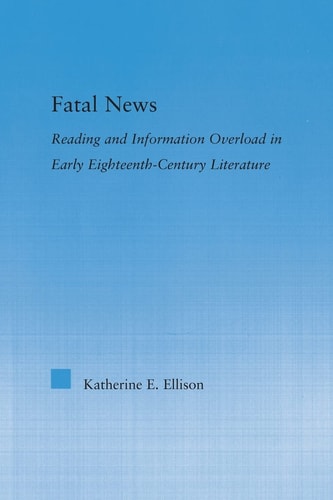
Fatal News Reading And Information Overload In Early Eighteenthcentury Literature 1st Edition Katherine E Ellison

  • SKU: BELL-239628734
Fatal News Reading And Information Overload In Early Eighteenthcentury Literature 1st Edition Katherine E Ellison
$ 35.00 $ 45.00 (-22%)

4.7

76 reviews

Fatal News Reading And Information Overload In Early Eighteenthcentury Literature 1st Edition Katherine E Ellison instant download after payment.

Publisher: Taylor & Francis Group
File Extension: PDF
File size: 6.29 MB
Pages: 158
Author: Katherine E. Ellison
ISBN: 9780415976268, 9780415867269, 9780203959688, 041597626X, 0415867266, 020395968X
Language: English
Year: 2005
Edition: 1

Product desciption

Fatal News Reading And Information Overload In Early Eighteenthcentury Literature 1st Edition Katherine E Ellison by Katherine E. Ellison 9780415976268, 9780415867269, 9780203959688, 041597626X, 0415867266, 020395968X instant download after payment.

What was "information" in the early eighteenth century, and what influence did the emergence of information, as potential physical and psychological threat, have on readers of the period? Recent scholarship in eighteenth-century print culture and in twenty-first-century media studies and theory offers a unique opportunity to reconsider how and why information is figuratively imagined during the eighteenth century as an abstract yet bodily entity that can flood, suffocate, and incapacitate readers. Focusing on 1678 to 1722 -- a period that experienced impressive innovations in communication -- this study reveals that the term "information" undergoes a significant transformation with social, cultural, and literary consequences. By investigating discussions of information and media that are evident in works by literary authors, the author finds that writers like John Bunyan, Aphra Behn, Jonathan Swift, and Daniel Defoe confront the idea of information overload and provide case studies in literacy reform that operate on institutional, generic, and consumer levels. For example, while in Defoe's Journal of the Plague Year information is infectious and citizens depend upon comets and phantoms to construct reader-controlled, decentralized media, in Swift's Tale of a Tub commonplace books and collections demonstrate a new type of organizational, or secretarial, impulse in society.

Related Products