Most ebook files are in PDF format, so you can easily read them using various software such as Foxit Reader or directly on the Google Chrome browser.
Some ebook files are released by publishers in other formats such as .awz, .mobi, .epub, .fb2, etc. You may need to install specific software to read these formats on mobile/PC, such as Calibre.
Please read the tutorial at this link: https://ebookbell.com/faq
We offer FREE conversion to the popular formats you request; however, this may take some time. Therefore, right after payment, please email us, and we will try to provide the service as quickly as possible.
For some exceptional file formats or broken links (if any), please refrain from opening any disputes. Instead, email us first, and we will try to assist within a maximum of 6 hours.
EbookBell Team
0.0
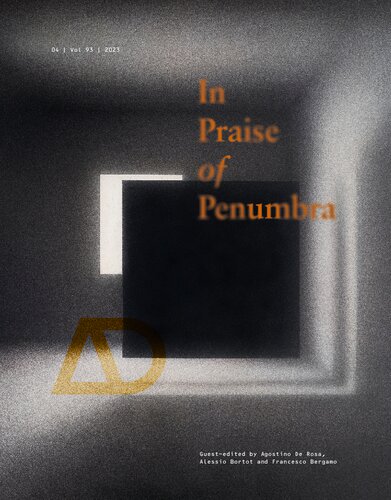
0 reviewsGuest-edited by Agostino De Rosa, Alessio Bortot and Francesco Bergamo
Penumbra, from the Latin paene (almost) and umbra (shadow), can be defined as an intermediate zone of transition between light and shadow. Penumbra is therefore that space, both physical and imaginary, where everything is possible: it is the place of the uncanny, where presence and/or absence can produce wonder or horror.
This AD positions the presence of this archetype in the contemporary world of architecture, investigating the ways it permeates different expressive forms – from critical theory to architectural drawing, from design and planning to photography. The contributors illustrate and discuss how penumbra has shaped their creativity and modified their approach to the design process. As a physical phenomenon, penumbra has supra-historical and global connotations; nonetheless, different cultures elaborate its symbolism in different ways. Its wide semantic spectrum powerfully inspires creative forms that hover between fullness and emptiness, presence and absence, past and future. The critical perspectives in this issue offer a wide analysis of penumbra’s expressive potential and the key to an in-depth understanding of this elusive layer of reality.
Contributors: Matthias Bärmann, Silvia Benedito, Filippo Bricolo, Edwin Carels, Javier Corvalán, Dris Kettani, Stephen Kite, Giancarlo Mazzanti, Akira Mizuta Lippit, Susanna Pisciella, Renato Rizzi, Paul O Robinson, and Antonella Soldaini.
Featured architects and artists: Alexander Savvich Brodsky, Neri&Hu studio, Quay Brothers, Ursula Schulz-Dornburg, and Marco Tirelli.