Most ebook files are in PDF format, so you can easily read them using various software such as Foxit Reader or directly on the Google Chrome browser.
Some ebook files are released by publishers in other formats such as .awz, .mobi, .epub, .fb2, etc. You may need to install specific software to read these formats on mobile/PC, such as Calibre.
Please read the tutorial at this link: https://ebookbell.com/faq
We offer FREE conversion to the popular formats you request; however, this may take some time. Therefore, right after payment, please email us, and we will try to provide the service as quickly as possible.
For some exceptional file formats or broken links (if any), please refrain from opening any disputes. Instead, email us first, and we will try to assist within a maximum of 6 hours.
EbookBell Team
4.8
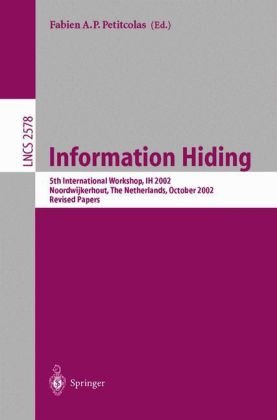
34 reviewsThese post-proceedings contain 27 papers that were accepted for presentation at the Fifth International Workshop on Information Hiding, held 7–9 October 2002, in Noordwijkerhout, The Netherlands. The papers were selected from 78 submissions on the basis of their scienti?c excellence and novelty by the program committee. We tried to have a balanced program covering several aspects of information hiding. The program committee was composed of Ross J. Anderson (Univ- sity of Cambridge, UK), Jan Camenisch (IBM Zurich Research Laboratory, Switzerland), Ingemar J. Cox (NEC Research Institute, USA), John McHugh (SEI/CERT, USA), Ira S. Moskowitz (Naval Research Laboratory, USA), Job Oostveen (Philips Research, The Netherlands), Andreas P?tzmann (Dresden University of Technology, Germany), Mike Reiter (Carnegie Mellon University, USA), and me. We all wish to thank all the authors of submissions for o?ering their papers for consideration. This year, contrary to the four previous workshops, the call for papers - quested anonymous submissions. However, anonymity was not compulsory and we did accept some papers in which the identity of the authors was clear. Each submission was assigned to three members of the program committee. Papers submitted by program committee members were assigned to four reviewers. The program committee relied on the advice of outside colleagues. We also insisted that 12 of the 27 accepted papers should be revised according to the comments of the reviewers.