Most ebook files are in PDF format, so you can easily read them using various software such as Foxit Reader or directly on the Google Chrome browser.
Some ebook files are released by publishers in other formats such as .awz, .mobi, .epub, .fb2, etc. You may need to install specific software to read these formats on mobile/PC, such as Calibre.
Please read the tutorial at this link: https://ebookbell.com/faq
We offer FREE conversion to the popular formats you request; however, this may take some time. Therefore, right after payment, please email us, and we will try to provide the service as quickly as possible.
For some exceptional file formats or broken links (if any), please refrain from opening any disputes. Instead, email us first, and we will try to assist within a maximum of 6 hours.
EbookBell Team
4.3
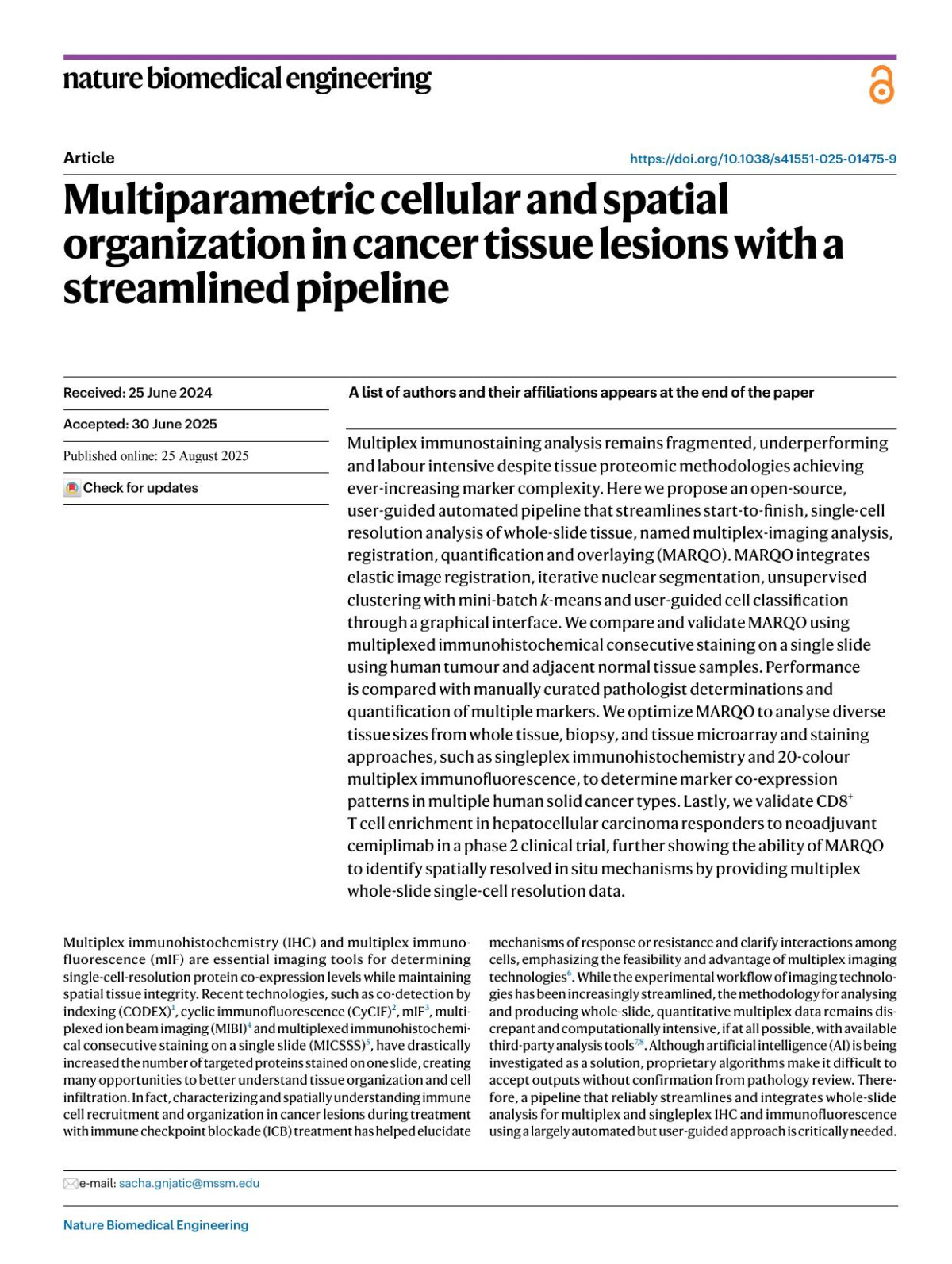
8 reviewsMultiplex immunostaining analysis remains fragmented, underperforming and labour intensive despite tissue proteomic methodologies achieving Check for updatesever-increasing marker complexity. Here we propose an open-source, user-guided automated pipeline that streamlines start-to-fnish, single-cell resolution analysis of whole-slide tissue, named multiplex-imaging analysis, registration, quantifcation and overlaying (MARQO). MARQO integrates elastic image registration, iterative nuclear segmentation, unsupervised clustering with mini-batch k-means and user-guided cell classifcation through a graphical interface. We compare and validate MARQO using multiplexed immunohistochemical consecutive staining on a single slide using human tumour and adjacent normal tissue samples. Performance is compared with manually curated pathologist determinations and quantifcation of multiple markers. We optimize MARQO to analyse diverse tissue sizes from whole tissue, biopsy, and tissue microarray and staining approaches, such as singleplex immunohistochemistry and 20-colour multiplex immunofuorescence, to determine marker co-expression patterns in multiple human solid cancer types. Lastly, we validate CD8+T cell enrichment in hepatocellular carcinoma responders to neoadjuvant cemiplimab in a phase 2 clinical trial, further showing the ability of MARQO to identify spatially resolved in situ mechanisms by providing multiplex whole-slide single-cell resolution data.