Most ebook files are in PDF format, so you can easily read them using various software such as Foxit Reader or directly on the Google Chrome browser.
Some ebook files are released by publishers in other formats such as .awz, .mobi, .epub, .fb2, etc. You may need to install specific software to read these formats on mobile/PC, such as Calibre.
Please read the tutorial at this link: https://ebookbell.com/faq
We offer FREE conversion to the popular formats you request; however, this may take some time. Therefore, right after payment, please email us, and we will try to provide the service as quickly as possible.
For some exceptional file formats or broken links (if any), please refrain from opening any disputes. Instead, email us first, and we will try to assist within a maximum of 6 hours.
EbookBell Team
4.7
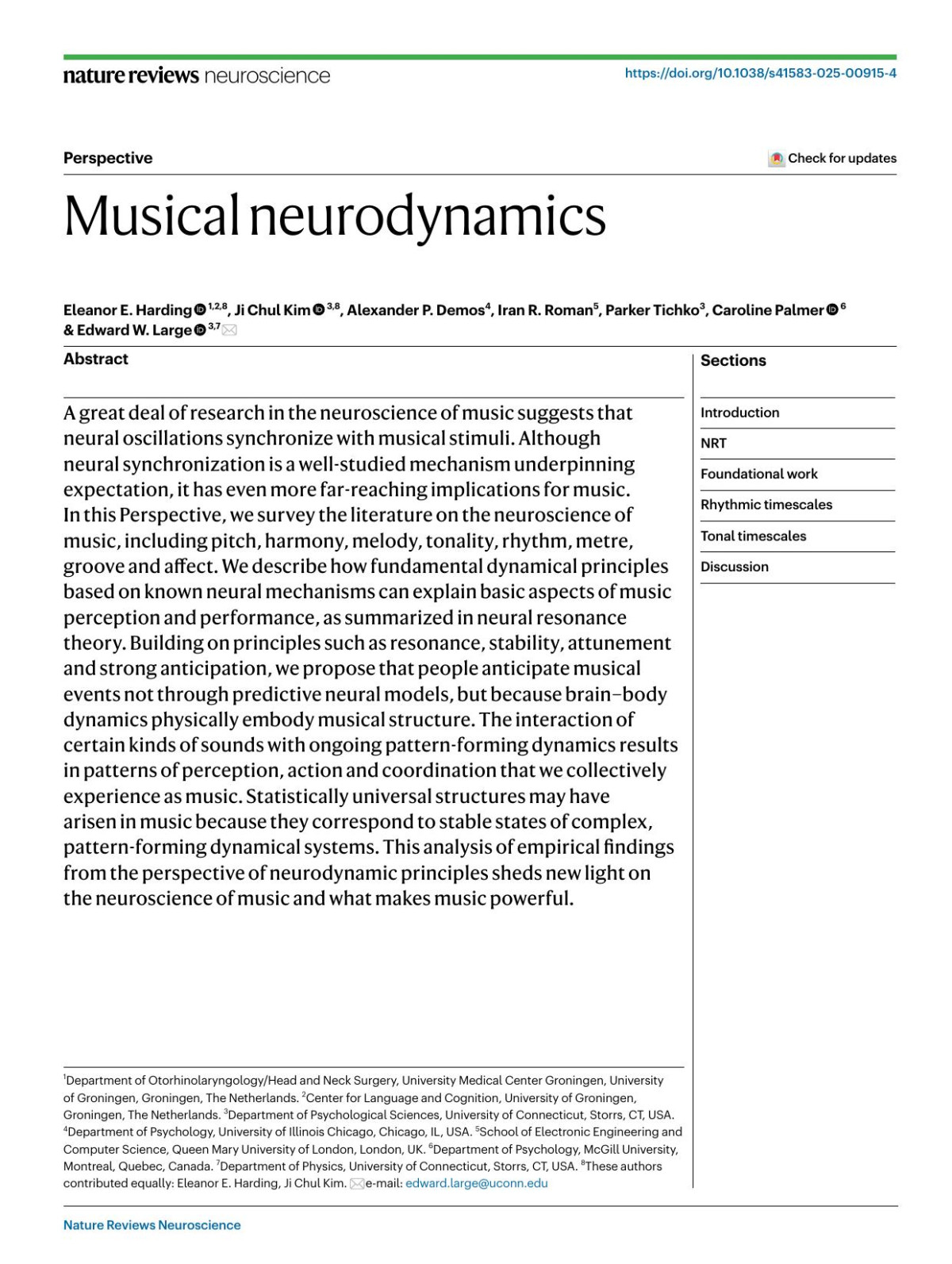
36 reviewsA great deal of research in the neuroscience of music suggests that Introductionneural oscillations synchronize with musical stimuli. Although NRTneural synchronization is a well-studied mechanism underpinning Foundational workexpectation, it has even more far-reaching implications for music. Rhythmic timescalesIn this Perspective, we survey the literature on the neuroscience of music, including pitch, harmony, melody, tonality, rhythm, metre, Tonal timescalesgroove and afect. We describe how fundamental dynamical principles Discussionbased on known neural mechanisms can explain basic aspects of music perception and performance, as summarized in neural resonance theory. Building on principles such as resonance, stability, attunement and strong anticipation, we propose that people anticipate musical events not through predictive neural models, but because brain–body dynamics physically embody musical structure. The interaction of certain kinds of sounds with ongoing pattern-forming dynamics results in patterns of perception, action and coordination that we collectively experience as music. Statistically universal structures may have arisen in music because they correspond to stable states of complex, pattern-forming dynamical systems. This analysis of empirical fndings from the perspective of neurodynamic principles sheds new light on the neuroscience of music and what makes music powerful.