Most ebook files are in PDF format, so you can easily read them using various software such as Foxit Reader or directly on the Google Chrome browser.
Some ebook files are released by publishers in other formats such as .awz, .mobi, .epub, .fb2, etc. You may need to install specific software to read these formats on mobile/PC, such as Calibre.
Please read the tutorial at this link: https://ebookbell.com/faq
We offer FREE conversion to the popular formats you request; however, this may take some time. Therefore, right after payment, please email us, and we will try to provide the service as quickly as possible.
For some exceptional file formats or broken links (if any), please refrain from opening any disputes. Instead, email us first, and we will try to assist within a maximum of 6 hours.
EbookBell Team
4.1
70 reviews
ISBN 10: 3110609223
ISBN 13: 978-3110609226
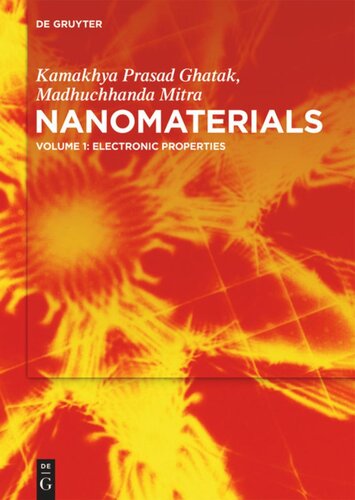
Author: Engg Kamakhya Prasad Ghatak, Madhuchhanda Mitra
The work studies under different physical conditions the carrier contribution to elastic constants in heavily doped optoelectronic materials. In the presence of intense photon field the authors apply the Heisenberg Uncertainty Principle to formulate electron statistics.
Many open research problems are discussed and numerous potential applications as quantum sensors and quantum cascade lasers are presented.
1 Heisenberg’s uncertainty principle (HUP) and the carrier contribution to the elastic constants in heavily doped (HD) optoelectronic nanomaterials in the presence of intense light waves
1.1 Introduction
1.2 Theoretical background
1.2.1 The CEC in the presence of light waves in HD III–V, ternary, and quaternary semiconductors
1.2.2 The CECs under magnetic quantization in HD Kane-type semiconductors in the presence of light waves
1.2.3 The CECs under crossed electric and quantizing magnetic fields in HD Kane-type semiconductors in the presence of light waves
1.2.4 The CECs in QWs of HD Kane-type semiconductors in the presence of light waves
1.2.5 The CECs in doping superlattices of HD Kane-type semiconductors in the presence of light waves
1.2.6 The CEC of QDs of HD Kane-type semiconductors in the presence of light waves
1.2.7 The magneto-CECs in QWs of HD Kane-type semiconductors in the presence of light waves
1.2.8 The CECs in accumulation and inversion layers of Kane-type semiconductors in the presence of light waves
1.2.9 The CECs in NWs of HD Kane-type semiconductors in the presence of light waves
1.2.10 The magneto-CECs in accumulation and inversion layers of Kane-type semiconductors in the presence of light waves
1.2.11 The magneto-CECs in doping superlattices of HD Kane-type semiconductors in the presence of light waves
1.2.12 The CECs in QWHD EMSLs of Kane-type semiconductors in the presence of light waves
1.2.13 The CECs in NWHD EMSLs of Kane-type semiconductors in the presence of light waves
1.2.14 The magneto-CECs in HD EMSLs of Kane-type semiconductors in the presence of light waves
1.2.15 The magneto-CECs in QWHD EMSLs of Kane-type semiconductors in the presence of light waves
1.2.16 The CECs in QWHD superlattices of Kane-type semiconductors with graded interfaces in the presence of light waves
1.2.17 The CECs in NWHD superlattices of Kane-type semiconductors with graded interfaces in the presence of light waves
1.2.18 The CECs in quantum dot HD superlattices of Kane-type semiconductors with graded interfaces in the presence of light waves
1.2.19 The magneto-CECs in HD superlattices of Kane-type semiconductors with graded interfaces in the presence of light waves
1.2.20 The magneto-CEC in QWHD superlattices of Kane-type semiconductors with graded interfaces in the presence of light waves
1.3 Suggestion for the experimental determination of CECs
1.4 Results and discussion
1.5 Open research problems
2 Heisenberg’s uncertainty principle and Einstein’s photoemission from HD optoelectronic nanomaterials in the presence of intense light waves
2.1 Introduction
2.2 Theoretical background
2.2.1 The HUP and EP from HD III–V, ternary and quaternary materials
2.2.2 Results and discussion
2.3 The HUP and EP from HD III–V, ternary and quaternary materials under magnetic quantization
2.3.1 Introduction
2.3.2 Theoretical background
2.3.3 Results and discussion
2.4 The HUP and EP from quantum wells (QWs), nanowires (NWs), and quantum dots (QDs) of HD III–V, ternary and quaternary materials
2.4.1 Introduction
2.4.2 Theoretical background
2.4.3 Results and discussion
2.5 The EP from HD effective mass superlattices of optoelectronic materials
2.5.1 Introduction
2.5.2 Theoretical background
2.5.3 Results and discussion
2.5.4 Open research problems
3 The Heisenberg’s uncertainty principle and the diffusivity to mobility ratio from HD optoelectronic nanomaterials in the presence of intense light waves
3.1 Introduction
3.2 Theoretical background
3.2.1 The DMR in the presence of light waves in HD III–V, ternary and quaternary semiconductors
3.2.2 The DMR under magnetic quantization in HD Kane-type semiconductors in the presence of light waves
3.2.3 The DMR under crossed electric and quantizing magnetic fields in HD Kane-type semiconductors in the presence of light waves
3.2.4 The DMR in 2D systems of HD Kane-type semiconductors in the presence of light waves
3.2.5 The DMR in nanowires (NWs) of HD Kane-type semiconductors in the presence of light waves
3.2.6 The DMR in QWHD effective mass superlattices of Kane-type semiconductors in the presence of light waves
3.2.7 The DMR in NWHD effective mass superlattices of Kane-type semiconductors in the presence of light waves
3.2.8 The DMR in QWHD superlattices of Kane-type semiconductors with graded interfaces in the presence of light waves
3.2.9 The DMR in NWHD superlattices of Kane-type semiconductors with graded interfaces in the presence of light waves
3.2.10 The magneto-DMR in HD superlattices of Kane-type semiconductors with graded interfaces in the presence of light waves
3.3 Open research problems
4 Heisenberg’s uncertainty principle and the screening length in heavily doped optoelectronic nanomaterials in the presence of intense light waves
4.1 Introduction
4.2 Theoretical background
4.2.1 The SL in the presence of light waves in HD III–V, ternary, and quaternary semiconductors
4.2.2 Suggestion for the experimental determination of SL
4.2.3 Results and discussion
4.2.4 2D SL systems of III–V, ternary, and quaternary semiconductors under external photoexcitation
4.2.5 The opto-SL in ternary and quaternary semiconductors under magnetic quantization
4.2.6 The opto-SL of III–V, ternary, and quaternary semiconductors under cross-field configuration
5 Heisenberg’s uncertainty principle and field emission in optoelectronic nanomaterials
5.1 Introduction
5.2 Theoretical background
5.2.1 Field emission from HD III–V, ternary and quaternary materials under magnetic quantization in the presence of light waves
5.2.2 Field emission from HD nanowire (NW) III–V, ternary and quaternary materials in the presence of light waves
5.2.3 Field emission from HD effective mass superlattices of III–V semiconductors in the presence of light waves under magnetic quantization
5.2.4 The field-emitted current from NWHD effective mass superlattices of Kane-type semiconductors in the presence of light waves
5.2.5 Field emission in the presence of strong light waves from HD superlattices of III–V, ternary and quaternary materials with graded interfaces under magnetic quantization
5.2.6 Field emission from HD quantum wire superlattices of III–V semiconductors with graded interfaces
5.3 Results and discussion
5.4 Open research problems
6 Conclusion and scope for future research
electronic properties of materials
volume of a nanoprism
electronic properties of nanomaterials pdf
nanomaterials pdf
electrical properties of nanomaterials pdf
Tags: Engg Kamakhya Prasad Ghatak, Madhuchhanda Mitra, Nanomaterials, Electronic Properties