Most ebook files are in PDF format, so you can easily read them using various software such as Foxit Reader or directly on the Google Chrome browser.
Some ebook files are released by publishers in other formats such as .awz, .mobi, .epub, .fb2, etc. You may need to install specific software to read these formats on mobile/PC, such as Calibre.
Please read the tutorial at this link: https://ebookbell.com/faq
We offer FREE conversion to the popular formats you request; however, this may take some time. Therefore, right after payment, please email us, and we will try to provide the service as quickly as possible.
For some exceptional file formats or broken links (if any), please refrain from opening any disputes. Instead, email us first, and we will try to assist within a maximum of 6 hours.
EbookBell Team
4.4
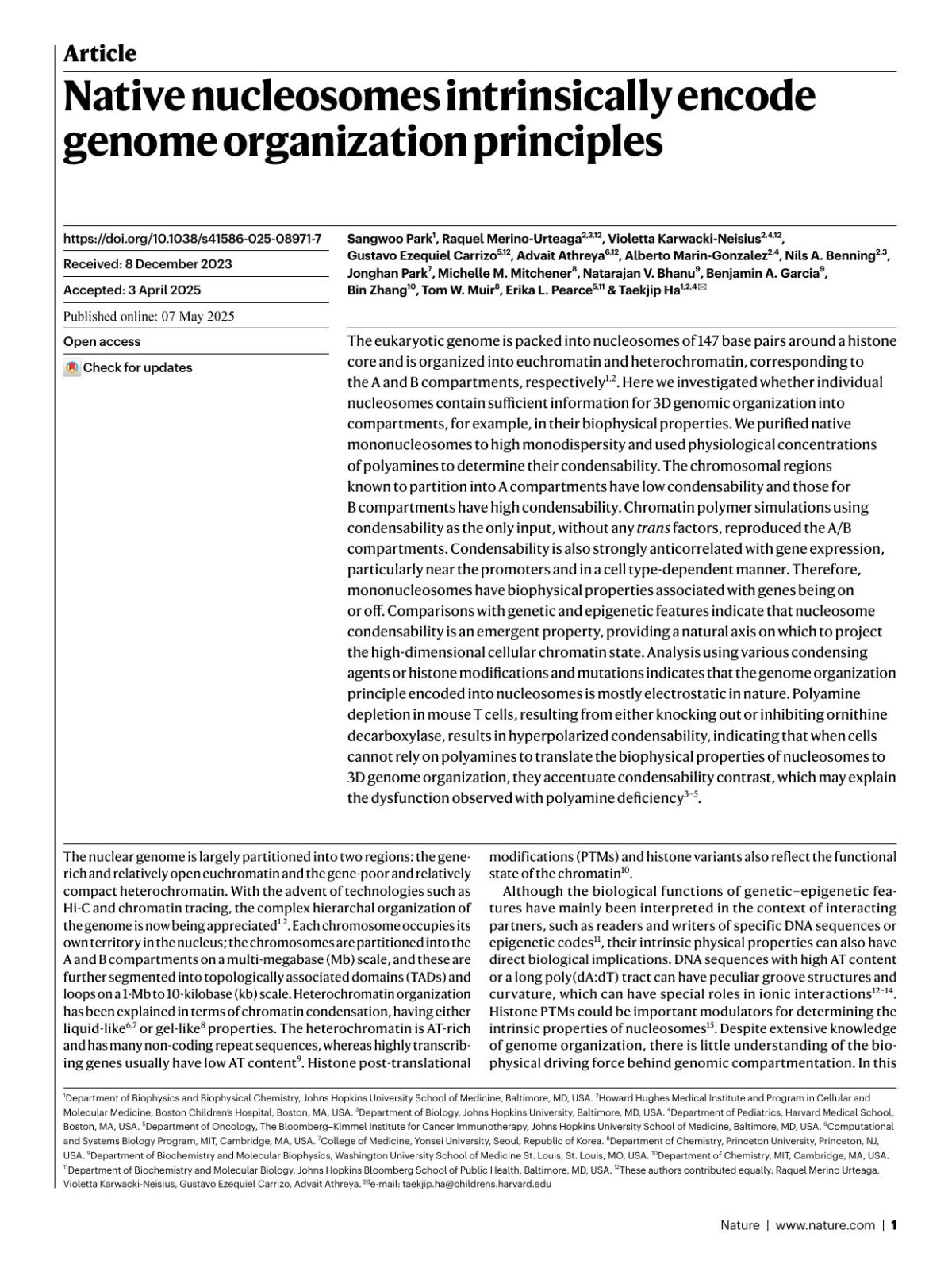
62 reviewsThe eukaryotic genome is packed into nucleosomes of 147 base pairs around a histone Check for updatescore and is organized into euchromatin and heterochromatin, corresponding to the A and B compartments, respectively1,2. Here we investigated whether individual nucleosomes contain sufcient information for 3D genomic organization into compartments, for example, in their biophysical properties. We purifed native mononucleosomes to high monodispersity and used physiological concentrations of polyamines to determine their condensability. The chromosomal regions known to partition into A compartments have low condensability and those for B compartments have high condensability. Chromatin polymer simulations using condensability as the only input, without any trans factors, reproduced the A/B compartments. Condensability is also strongly anticorrelated with gene expression, particularly near the promoters and in a cell type-dependent manner. Therefore, mononucleosomes have biophysical properties associated with genes being on or of. Comparisons with genetic and epigenetic features indicate that nucleosome condensability is an emergent property, providing a natural axis on which to project the high-dimensional cellular chromatin state. Analysis using various condensing agents or histone modifcations and mutations indicates that the genome organization principle encoded into nucleosomes is mostly electrostatic in nature. Polyamine depletion in mouse T cells, resulting from either knocking out or inhibiting ornithine decarboxylase, results in hyperpolarized condensability, indicating that when cells cannot rely on polyamines to translate the biophysical properties of nucleosomes to 3D genome organization, they accentuate condensability contrast, which may explain the dysfunction observed with polyamine defciency3–5.