logo

EbookBell.com

Most ebook files are in PDF format, so you can easily read them using various software such as Foxit Reader or directly on the Google Chrome browser.
Some ebook files are released by publishers in other formats such as .awz, .mobi, .epub, .fb2, etc. You may need to install specific software to read these formats on mobile/PC, such as Calibre.

Please read the tutorial at this link:  https://ebookbell.com/faq 


We offer FREE conversion to the popular formats you request; however, this may take some time. Therefore, right after payment, please email us, and we will try to provide the service as quickly as possible.


For some exceptional file formats or broken links (if any), please refrain from opening any disputes. Instead, email us first, and we will try to assist within a maximum of 6 hours.

EbookBell Team
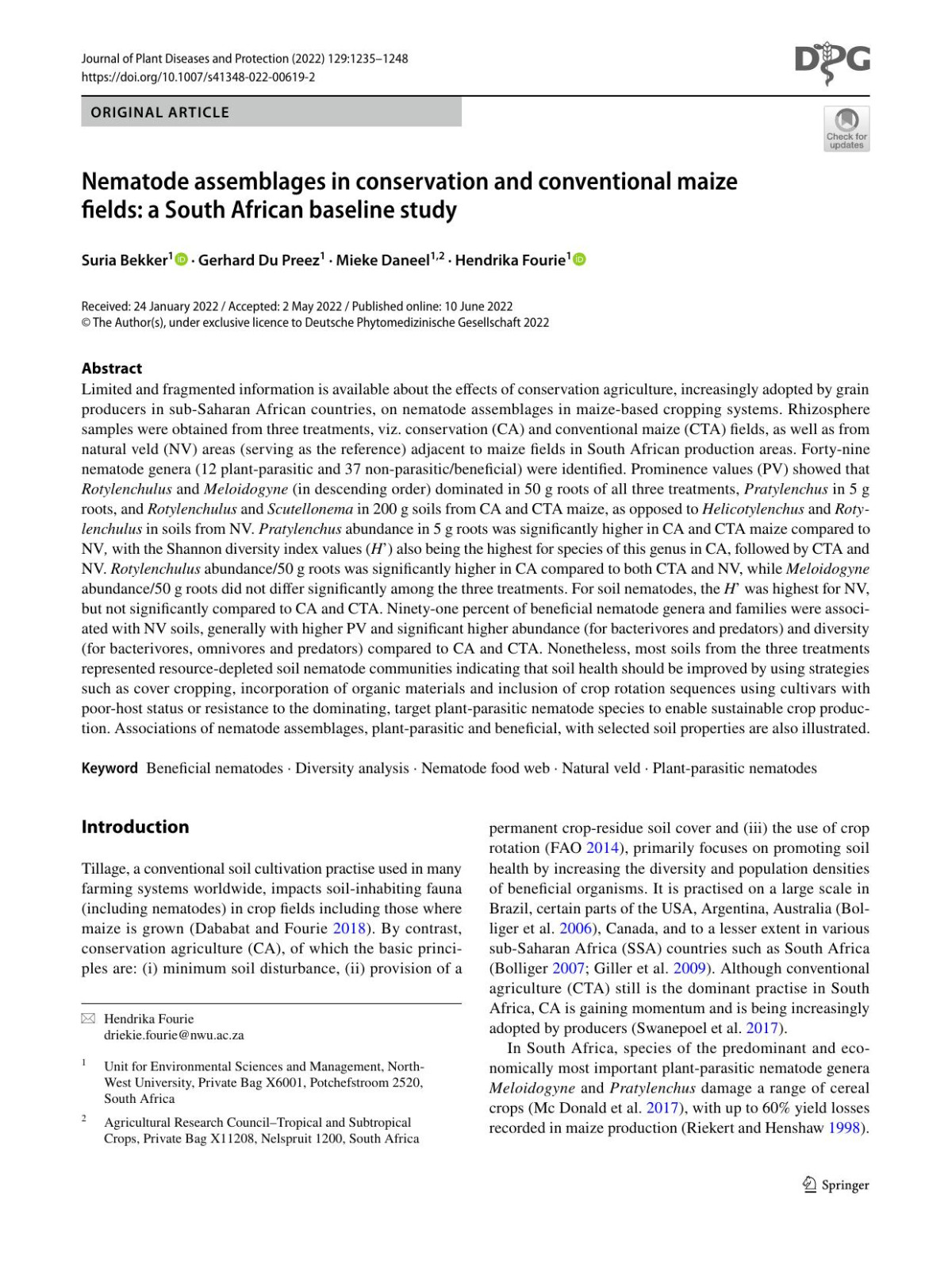
Nematode Assemblages In Conservation And Conventional Maize Fields A South African Baseline Study Suria Bekker Gerhard Du Preez Mieke Daneel Hendrika Fourie

  • SKU: BELL-236226276
Nematode Assemblages In Conservation And Conventional Maize Fields A South African Baseline Study Suria Bekker Gerhard Du Preez Mieke Daneel Hendrika Fourie
$ 35.00 $ 45.00 (-22%)

5.0

48 reviews

Nematode Assemblages In Conservation And Conventional Maize Fields A South African Baseline Study Suria Bekker Gerhard Du Preez Mieke Daneel Hendrika Fourie instant download after payment.

Publisher: Springer Berlin Heidelberg
File Extension: PDF
File size: 1.17 MB
Author: Suria Bekker & Gerhard Du Preez & Mieke Daneel & Hendrika Fourie
ISBN: 101007/S41348022006192
Language: English
Year: 2022
Volume: 129

Product desciption

Nematode Assemblages In Conservation And Conventional Maize Fields A South African Baseline Study Suria Bekker Gerhard Du Preez Mieke Daneel Hendrika Fourie by Suria Bekker & Gerhard Du Preez & Mieke Daneel & Hendrika Fourie 101007/S41348022006192 instant download after payment.

Limited and fragmented information is available about the effects of conservation agriculture, increasingly adopted by grain producers in sub-Saharan African countries, on nematode assemblages in maize-based cropping systems. Rhizosphere samples were obtained from three treatments, viz. conservation (CA) and conventional maize (CTA) fields, as well as from natural veld (NV) areas (serving as the reference) adjacent to maize fields in South African production areas. Forty-nine nematode genera (12 plant-parasitic and 37 non-parasitic/beneficial) were identified. Prominence values (PV) showed that Rotylenchulus and Meloidogyne (in descending order) dominated in 50 g roots of all three treatments, Pratylenchus in 5 g roots, and Rotylenchulus and Scutellonema in 200 g soils from CA and CTA maize, as opposed to Helicotylenchus and Rotylenchulus in soils from NV. Pratylenchus abundance in 5 g roots was significantly higher in CA and CTA maize compared to NV, with the Shannon diversity index values (H’) also being the highest for species of this genus in CA, followed by CTA and NV. Rotylenchulus abundance/50 g roots was significantly higher in CA compared to both CTA and NV, while Meloidogyne abundance/50 g roots did not differ significantly among the three treatments. For soil nematodes, the H’ was highest for NV, but not significantly compared to CA and CTA. Ninety-one percent of beneficial nematode genera and families were associated with NV soils, generally with higher PV and significant higher abundance (for bacterivores and predators) and diversity (for bacterivores, omnivores and predators) compared to CA and CTA. Nonetheless, most soils from the three treatments represented resource-depleted soil nematode communities indicating that soil health should be improved by using strategies such as cover cropping, incorporation of organic materials and inclusion of crop rotation sequences using cultivars with poor-host status or resistance to the dominating...

Related Products