Most ebook files are in PDF format, so you can easily read them using various software such as Foxit Reader or directly on the Google Chrome browser.
Some ebook files are released by publishers in other formats such as .awz, .mobi, .epub, .fb2, etc. You may need to install specific software to read these formats on mobile/PC, such as Calibre.
Please read the tutorial at this link: https://ebookbell.com/faq
We offer FREE conversion to the popular formats you request; however, this may take some time. Therefore, right after payment, please email us, and we will try to provide the service as quickly as possible.
For some exceptional file formats or broken links (if any), please refrain from opening any disputes. Instead, email us first, and we will try to assist within a maximum of 6 hours.
EbookBell Team
4.4
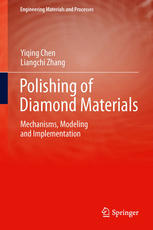
32 reviewsDiamond has a unique combination of properties, such as the highest hardness and thermal conductivity among any known material, high electrical resistivity, a large optical band gap and a high transmission, good resistance to chemical erosion, low adhesion and friction, and extremely low thermal expansion coefficient. As such, diamond has been a desirable material in a wide range of applications in mechanical, chemical, optical, thermal and electrical engineering. In many of the cases, the surface of a diamond component or element must have a superior finish, often down to a surface roughness of nanometers. Nevertheless, due to its extreme hardness and chemical inertness, the polishing of diamond and its composites has been a sophisticated process.
Polishing of Diamond Materials will provide a state-of-the-art analysis, both theoretically and experimentally, of the most commonly used polishing techniques for mono/poly-crystalline diamond and chemical vapour deposition (CVD) diamond films, including mechanical, chemo-mechanical, thermo-chemical, high energy beam, dynamic friction and other polishing techniques. The in-depth discussions will be on the polishing mechanisms, possible modelling, material removal rate and the quality control of these techniques. A comparison of their advantages and drawbacks will be carried out to provide the reader with a useful guideline for the selection and implementation of these polishing techniques.
Polishing of Diamond Materials will be of interest to researchers and engineers in hard materials and precision manufacturing, industry diamond suppliers, diamond jewellery suppliers and postgraduate students in the area of precision manufacturing.