logo

EbookBell.com

Most ebook files are in PDF format, so you can easily read them using various software such as Foxit Reader or directly on the Google Chrome browser.
Some ebook files are released by publishers in other formats such as .awz, .mobi, .epub, .fb2, etc. You may need to install specific software to read these formats on mobile/PC, such as Calibre.

Please read the tutorial at this link:  https://ebookbell.com/faq 


We offer FREE conversion to the popular formats you request; however, this may take some time. Therefore, right after payment, please email us, and we will try to provide the service as quickly as possible.


For some exceptional file formats or broken links (if any), please refrain from opening any disputes. Instead, email us first, and we will try to assist within a maximum of 6 hours.

EbookBell Team
Quantifying The Impact Of Hair And Skin Characteristics On Fnirs Signal Quality For Enhanced Inclusivity Meryem A Yampx000fccel Jessica E Anderson Deampx02019ja Rogers Parisa Hajirahimi Parya Farzam Yuanyuan Gao Rini I Kaplan Emily J Braun Nishaat Mukadam Sudan Duwadi Laura Carlton David Beeler Lindsay K Butler Erin

  • SKU: BELL-239581304
Quantifying The Impact Of Hair And Skin Characteristics On Fnirs Signal Quality For Enhanced Inclusivity Meryem A Yampx000fccel Jessica E Anderson Deampx02019ja Rogers Parisa Hajirahimi Parya Farzam Yuanyuan Gao Rini I Kaplan Emily J Braun Nishaat Mukadam Sudan Duwadi Laura Carlton David Beeler Lindsay K Butler Erin
$ 35.00 $ 45.00 (-22%)

4.0

56 reviews

Quantifying The Impact Of Hair And Skin Characteristics On Fnirs Signal Quality For Enhanced Inclusivity Meryem A Yampx000fccel Jessica E Anderson Deampx02019ja Rogers Parisa Hajirahimi Parya Farzam Yuanyuan Gao Rini I Kaplan Emily J Braun Nishaat Mukadam Sudan Duwadi Laura Carlton David Beeler Lindsay K Butler Erin instant download after payment.

Publisher: x
File Extension: PDF
File size: 5.5 MB
Author: Meryem A. Yamp#x000FC;cel & Jessica E. Anderson & Deamp#x02019;Ja Rogers & Parisa Hajirahimi & Parya Farzam & Yuanyuan Gao & Rini I. Kaplan & Emily J. Braun & Nishaat Mukadam & Sudan Duwadi & Laura Carlton & David Beeler & Lindsay K. Butler & Erin...
Language: English
Year: 2025

Product desciption

Quantifying The Impact Of Hair And Skin Characteristics On Fnirs Signal Quality For Enhanced Inclusivity Meryem A Yampx000fccel Jessica E Anderson Deampx02019ja Rogers Parisa Hajirahimi Parya Farzam Yuanyuan Gao Rini I Kaplan Emily J Braun Nishaat Mukadam Sudan Duwadi Laura Carlton David Beeler Lindsay K Butler Erin by Meryem A. Yamp#x000fc;cel & Jessica E. Anderson & Deamp#x02019;ja Rogers & Parisa Hajirahimi & Parya Farzam & Yuanyuan Gao & Rini I. Kaplan & Emily J. Braun & Nishaat Mukadam & Sudan Duwadi & Laura Carlton & David Beeler & Lindsay K. Butler & Erin... instant download after payment.

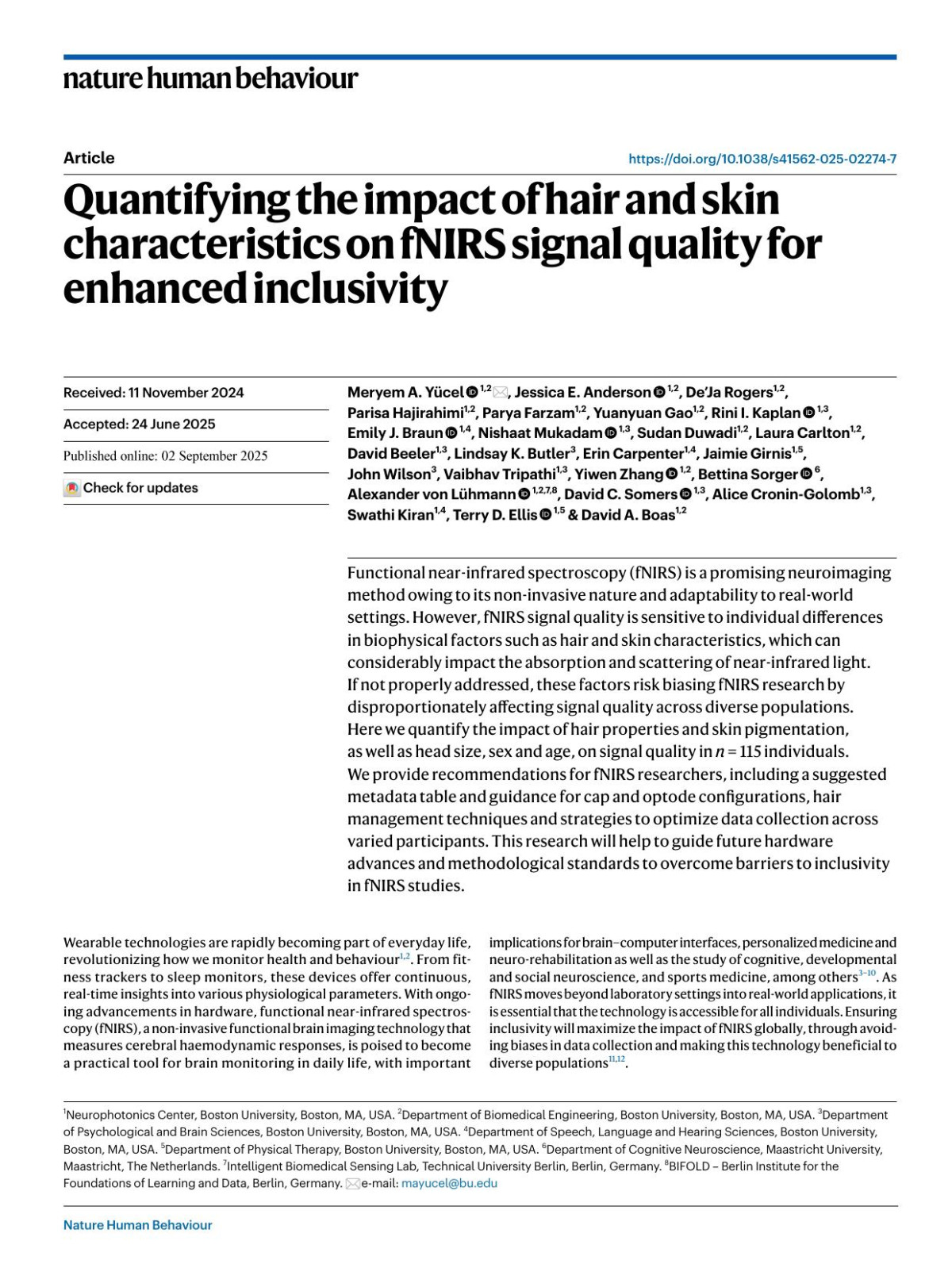
Comportamento umano della natura, doi:10.1038/s41562-025-02274-7

La spettroscopia funzionale nel vicino infrarosso (fNIRS) è un metodo di neuroimaging promettente grazie alla sua natura non invasiva e all'adattabilità a contesti reali. Tuttavia, la qualità del segnale fNIRS è sensibile alle differenze individuali in fattori biofisici come le caratteristiche dei capelli e della pelle, che possono influire considerevolmente sull'assorbimento e la diffusione della luce nel vicino infrarosso. Se non adeguatamente affrontati, questi fattori rischiano di influenzare negativamente la ricerca fNIRS, influenzando in modo sproporzionato la qualità del segnale in diverse popolazioni. In questo studio quantifichiamo l'impatto delle proprietà dei capelli e della pigmentazione della pelle, nonché delle dimensioni della testa, del sesso e dell'età, sulla qualità del segnale in n = 115 individui. Forniamo raccomandazioni per i ricercatori fNIRS, tra cui una tabella di metadati suggerita e linee guida per le configurazioni di capello e optodo, tecniche di gestione dei capelli e strategie per ottimizzare la raccolta dati tra i diversi partecipanti. Questa ricerca contribuirà a guidare i futuri progressi hardware e gli standard metodologici per superare le barriere all'inclusività negli studi fNIRS.