logo

EbookBell.com

Most ebook files are in PDF format, so you can easily read them using various software such as Foxit Reader or directly on the Google Chrome browser.
Some ebook files are released by publishers in other formats such as .awz, .mobi, .epub, .fb2, etc. You may need to install specific software to read these formats on mobile/PC, such as Calibre.

Please read the tutorial at this link:  https://ebookbell.com/faq 


We offer FREE conversion to the popular formats you request; however, this may take some time. Therefore, right after payment, please email us, and we will try to provide the service as quickly as possible.


For some exceptional file formats or broken links (if any), please refrain from opening any disputes. Instead, email us first, and we will try to assist within a maximum of 6 hours.

EbookBell Team
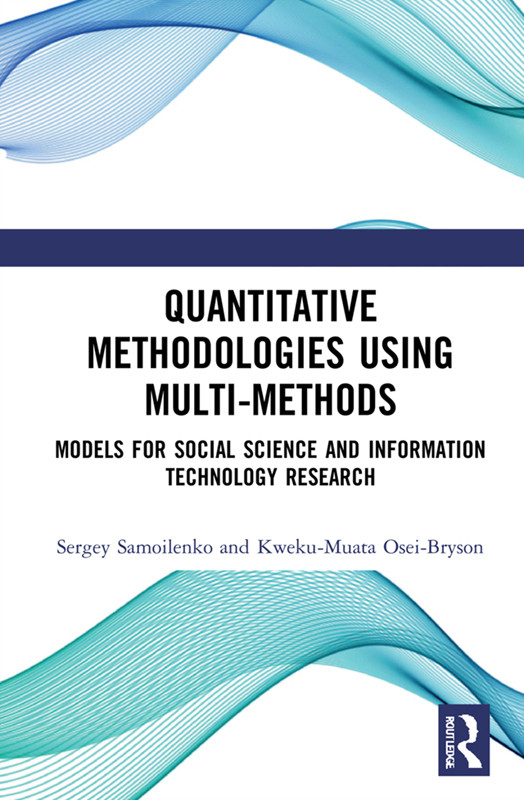
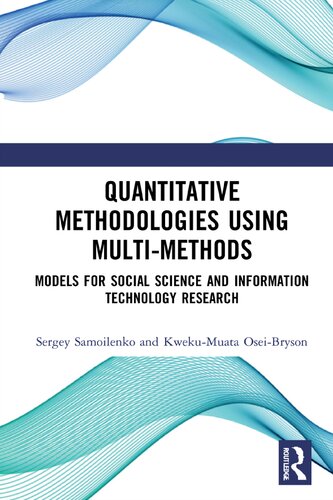
Quantitative Methodologies Using Multimethods Models For Social Science And Information Technology Research Sergey V Samoilenko Kwekumuata Oseibryson

  • SKU: BELL-237389374
Quantitative Methodologies Using Multimethods Models For Social Science And Information Technology Research Sergey V Samoilenko Kwekumuata Oseibryson
$ 35.00 $ 45.00 (-22%)

4.7

96 reviews

Quantitative Methodologies Using Multimethods Models For Social Science And Information Technology Research Sergey V Samoilenko Kwekumuata Oseibryson instant download after payment.

Publisher: Routledge
File Extension: EPUB
File size: 3.27 MB
Author: Sergey V. Samoilenko & Kweku-Muata Osei-Bryson
Language: English
Year: 2021

Product desciption

Quantitative Methodologies Using Multimethods Models For Social Science And Information Technology Research Sergey V Samoilenko Kwekumuata Oseibryson by Sergey V. Samoilenko & Kweku-muata Osei-bryson instant download after payment.

Quantitative Methodologies using Multi-Methods is a multifaceted book written to help researchers. It is a user-friendly introduction to the popular methods of data mining and data analysis. The book avoids getting involved into details that are more suitable for a more advanced users; it is written for readers who have, at most, a surface-level knowledge of the methods presented in the book. The book is also an introductory guide to the subject of complementarity of the tools and techniques of data analysis. It shows how methods could be used in synergy to offer insights into the issues that could not be dissected by any single method alone.
This text can also be used as a set of templates, where, given a set of research questions, the investigator could identify a set of methodological modules allowing for answering the research questions of interest. This is not entirely unlike the relationship between analysis and design phases of the systems development life cycle- where the “What? ” of the analysis phase has to be translated into the “How ” of the design phase. The book can guide the identification of modules (the “How ”) that are suitable for answering research questions (the “What ”). It can aid in transitioning a conceptual domain of the research questions into a scaffolding of data analytic and data mining methods.
The book is also a guide to exploring what data under investigation holds. For example, an investigator may use the methodological modules presented in this book to generate a set of preliminary questions which, after a careful consideration and a requisite culling, could be formulated into a set of questions consistent within a selected theory or a framework. Finally, the book can be used as a generator of new research questions. Applying every method in each of the book's modules opens a new dimension ripe with follow-up questions of the type “Why is this so? ” The answers to this question may provide new insight and lead to the development of n

Related Products