logo

EbookBell.com

Most ebook files are in PDF format, so you can easily read them using various software such as Foxit Reader or directly on the Google Chrome browser.
Some ebook files are released by publishers in other formats such as .awz, .mobi, .epub, .fb2, etc. You may need to install specific software to read these formats on mobile/PC, such as Calibre.

Please read the tutorial at this link:  https://ebookbell.com/faq 


We offer FREE conversion to the popular formats you request; however, this may take some time. Therefore, right after payment, please email us, and we will try to provide the service as quickly as possible.


For some exceptional file formats or broken links (if any), please refrain from opening any disputes. Instead, email us first, and we will try to assist within a maximum of 6 hours.

EbookBell Team
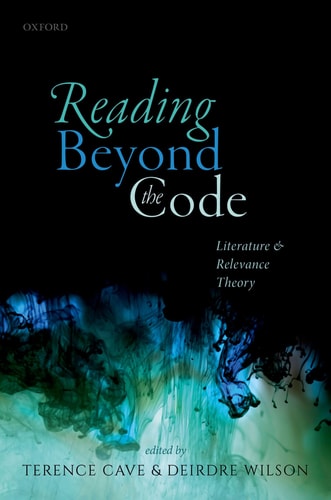
Reading Beyond The Code Literature And Relevance Theory Illustrated Terence Cave Editor

  • SKU: BELL-238556612
Reading Beyond The Code Literature And Relevance Theory Illustrated Terence Cave Editor
$ 35.00 $ 45.00 (-22%)

4.8

14 reviews

Reading Beyond The Code Literature And Relevance Theory Illustrated Terence Cave Editor instant download after payment.

Publisher: Oxford University Press
File Extension: PDF
File size: 15.28 MB
Pages: 243
Author: Terence Cave (editor), Deirdre Wilson (editor)
ISBN: 9780198794776, 0198794770
Language: English
Year: 2018
Edition: Illustrated

Product desciption

Reading Beyond The Code Literature And Relevance Theory Illustrated Terence Cave Editor by Terence Cave (editor), Deirdre Wilson (editor) 9780198794776, 0198794770 instant download after payment.

This book explores the value for literary studies of relevance theory, an inferential approach to communication in which the expression and recognition of intentions plays a major role. Drawing on a wide range of examples from lyric poetry and the novel, nine of the ten chapters are written by literary specialists and use relevance theory both as an overall framework and as a resource for detailed analysis. The final chapter, written by the co-founder of relevance theory, reviews the issues addressed by the volume and explores their implications for cognitive theories of how communicative acts are interpreted in context. Originally designed to explain how people understand each other in everyday face-to-face exchanges, relevance theory—described in an early review by a literary scholar as ‘the makings of a radically new theory of communication, the first since Aristotle’s’—sheds light on the whole spectrum of human modes of communication, including literature in the broadest sense. Reading Beyond the Code is unique in using relevance theory as a prime resource for literary study, and is also the first to apply the model to a range of phenomena widely seen as supporting an ‘embodied’ conception of cognition and language where sensorimotor processes play a key role. This broadened perspective serves to enhance the value for literary studies of the central claim of relevance theory: that the ‘code model’ is fundamentally inadequate to account for human communication, and in particular for the modes of communication that are proper to literature.

Related Products