logo

EbookBell.com

Most ebook files are in PDF format, so you can easily read them using various software such as Foxit Reader or directly on the Google Chrome browser.
Some ebook files are released by publishers in other formats such as .awz, .mobi, .epub, .fb2, etc. You may need to install specific software to read these formats on mobile/PC, such as Calibre.

Please read the tutorial at this link:  https://ebookbell.com/faq 


We offer FREE conversion to the popular formats you request; however, this may take some time. Therefore, right after payment, please email us, and we will try to provide the service as quickly as possible.


For some exceptional file formats or broken links (if any), please refrain from opening any disputes. Instead, email us first, and we will try to assist within a maximum of 6 hours.

EbookBell Team
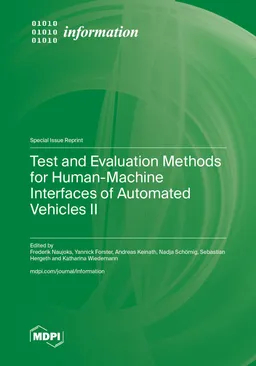
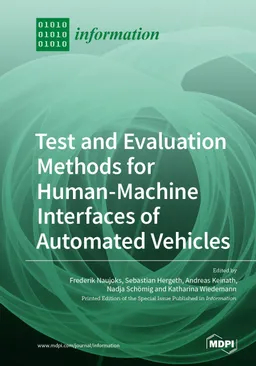
Test And Evaluation Methods For Humanmachine Interfaces Of Automated Vehicles Ii Frederik Naujoks

  • SKU: BELL-237775728
Test And Evaluation Methods For Humanmachine Interfaces Of Automated Vehicles Ii Frederik Naujoks
$ 35.00 $ 45.00 (-22%)

4.1

70 reviews

Test And Evaluation Methods For Humanmachine Interfaces Of Automated Vehicles Ii Frederik Naujoks instant download after payment.

Publisher: MDPI
File Extension: PDF
File size: 22.48 MB
Pages: 184
Author: Frederik Naujoks, Yannick Forster, Andreas Keinath, Nadja Schömig, Sebastian Hergeth, Katharina Wiedemann
ISBN: 9783725846382, 9783725846375, 3725846383, 3725846375
Language: English
Year: 2025

Product desciption

Test And Evaluation Methods For Humanmachine Interfaces Of Automated Vehicles Ii Frederik Naujoks by Frederik Naujoks, Yannick Forster, Andreas Keinath, Nadja Schömig, Sebastian Hergeth, Katharina Wiedemann 9783725846382, 9783725846375, 3725846383, 3725846375 instant download after payment.

With the introduction of automated driving systems (ADSs) and advanced driver assistance systems, the communication of the driver’s responsibilities and the AD’s capabilities has become an important topic in recent years. For example, partially automated driving (SAE L2) systems need to be able to communicate that the driver is still fully responsible for driving safety, whereas higher levels of vehicle automation need to be able to communicate that the driver has to act as a fallback-ready user in case of system limits and malfunctions (SAE L3). 
-
During the same trip, different levels of automation might be available to the driver, making it even more crucial that the driving mode is efficiently displayed. These developments require new, standardized tests and evaluating methods for in-vehicle Human–Machine Interfaces (HMIs). This Special Issue includes theoretical papers as well as empirical studies that propose new and innovative test methods in the evaluation of ADS HMIs.

Related Products