Most ebook files are in PDF format, so you can easily read them using various software such as Foxit Reader or directly on the Google Chrome browser.
Some ebook files are released by publishers in other formats such as .awz, .mobi, .epub, .fb2, etc. You may need to install specific software to read these formats on mobile/PC, such as Calibre.
Please read the tutorial at this link: https://ebookbell.com/faq
We offer FREE conversion to the popular formats you request; however, this may take some time. Therefore, right after payment, please email us, and we will try to provide the service as quickly as possible.
For some exceptional file formats or broken links (if any), please refrain from opening any disputes. Instead, email us first, and we will try to assist within a maximum of 6 hours.
EbookBell Team
5.0
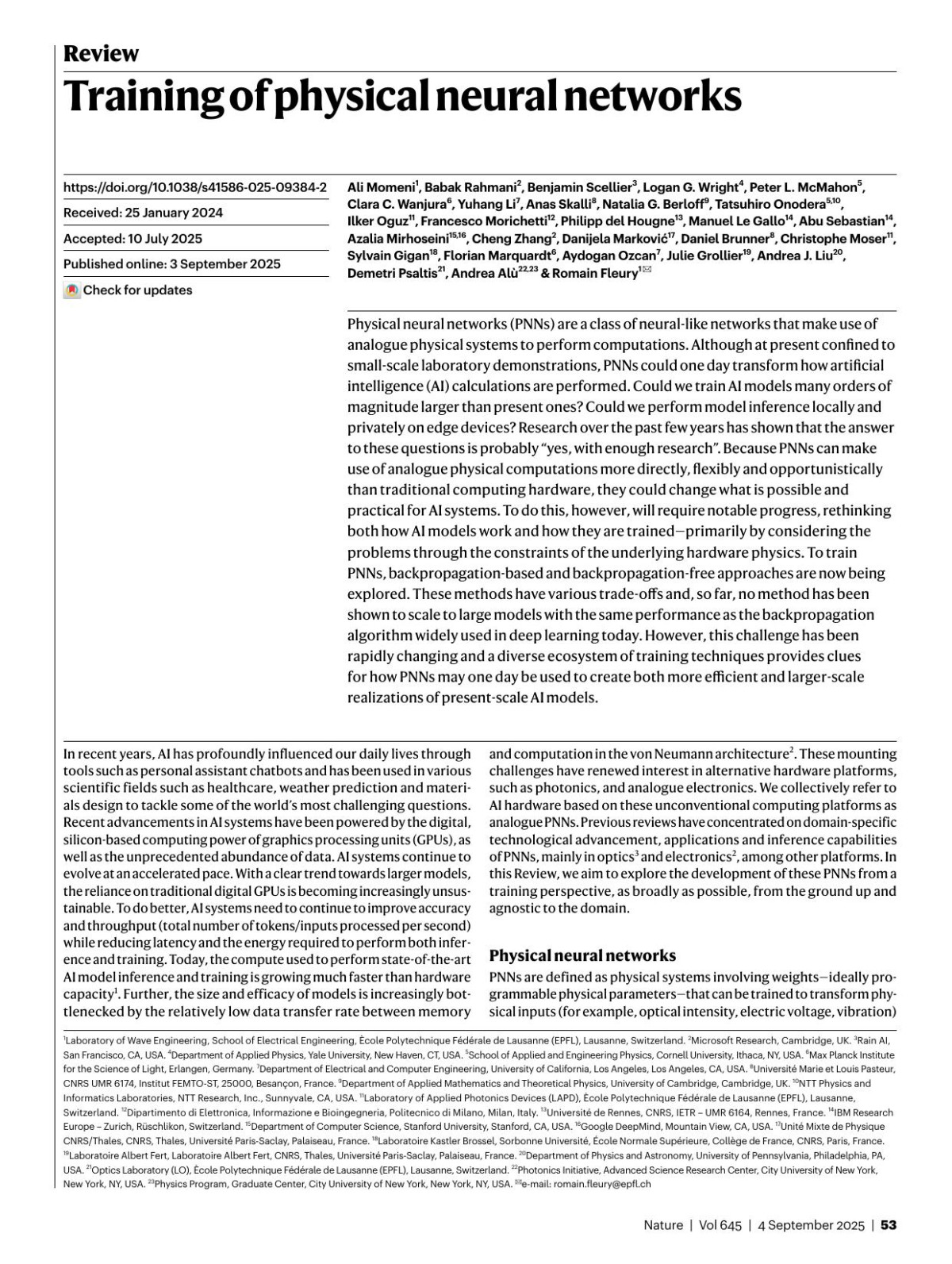
38 reviewsPhysical neural networks (PNNs) are a class of neural-like networks that make use of analogue physical systems to perform computations. Although at present confned to small-scale laboratory demonstrations, PNNs could one day transform how artifcial intelligence (AI) calculations are performed. Could we train AI models many orders of magnitude larger than present ones? Could we perform model inference locally and privately on edge devices? Research over the past few years has shown that the answer to these questions is probably “yes, with enough research”. Because PNNs can make use of analogue physical computations more directly, fexibly and opportunistically than traditional computing hardware, they could change what is possible and practical for AI systems. To do this, however, will require notable progress, rethinking both how AI models work and how they are trained—primarily by considering the problems through the constraints of the underlying hardware physics. To train PNNs, backpropagation-based and backpropagation-free approaches are now being explored. These methods have various trade-ofs and, so far, no method has been shown to scale to large models with the same performance as the backpropagation algorithm widely used in deep learning today. However, this challenge has been rapidly changing and a diverse ecosystem of training techniques provides clues for how PNNs may one day be used to create both more efcient and larger-scale realizations of present-scale AI models.