logo

EbookBell.com

Most ebook files are in PDF format, so you can easily read them using various software such as Foxit Reader or directly on the Google Chrome browser.
Some ebook files are released by publishers in other formats such as .awz, .mobi, .epub, .fb2, etc. You may need to install specific software to read these formats on mobile/PC, such as Calibre.

Please read the tutorial at this link:  https://ebookbell.com/faq 


We offer FREE conversion to the popular formats you request; however, this may take some time. Therefore, right after payment, please email us, and we will try to provide the service as quickly as possible.


For some exceptional file formats or broken links (if any), please refrain from opening any disputes. Instead, email us first, and we will try to assist within a maximum of 6 hours.

EbookBell Team

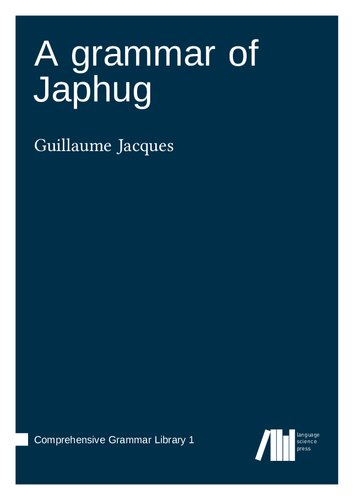
A Grammar Of Japhug Second Edition 2nd Edition Guillaume Jacques

  • SKU: BELL-239958976
A Grammar Of Japhug Second Edition 2nd Edition Guillaume Jacques
$ 35.00 $ 45.00 (-22%)

5.0

98 reviews

A Grammar Of Japhug Second Edition 2nd Edition Guillaume Jacques instant download after payment.

Publisher: Language Science Press
File Extension: PDF
File size: 6.41 MB
Pages: 1616
Author: Guillaume Jacques
ISBN: 9783961105380, 3961105383
Language: English
Year: 2025
Edition: 2

Product desciption

A Grammar Of Japhug Second Edition 2nd Edition Guillaume Jacques by Guillaume Jacques 9783961105380, 3961105383 instant download after payment.

Japhug is a vulnerable Gyalrongic language, which belongs to the Trans-Himalayan (Sino-Tibetan) family. It is spoken by several thousand speakers in Mbarkham county, Rngaba district, Sichuan province, China. This grammar is the result of nearly 20 years of fieldwork on one variety of Japhug, based on a corpus of narratives and conversations, a large part of which is available from the Pangloss Collection. It covers the whole grammar of the language, and the text examples provide a unique insight into Gyalrong culture. It was written with a general linguistics audience in mind, and should prove useful not only to specialists of Trans-Himalayan historical linguistics and typologists, but also to anthropologists doing research in Gyalrong areas. It is also hoped that some readers will use it to learn Japhug and pursue research on this fascinating language in the future.

This book is a revised version of (A grammar of Japhug)