Most ebook files are in PDF format, so you can easily read them using various software such as Foxit Reader or directly on the Google Chrome browser.
Some ebook files are released by publishers in other formats such as .awz, .mobi, .epub, .fb2, etc. You may need to install specific software to read these formats on mobile/PC, such as Calibre.
Please read the tutorial at this link: https://ebookbell.com/faq
We offer FREE conversion to the popular formats you request; however, this may take some time. Therefore, right after payment, please email us, and we will try to provide the service as quickly as possible.
For some exceptional file formats or broken links (if any), please refrain from opening any disputes. Instead, email us first, and we will try to assist within a maximum of 6 hours.
EbookBell Team
4.1
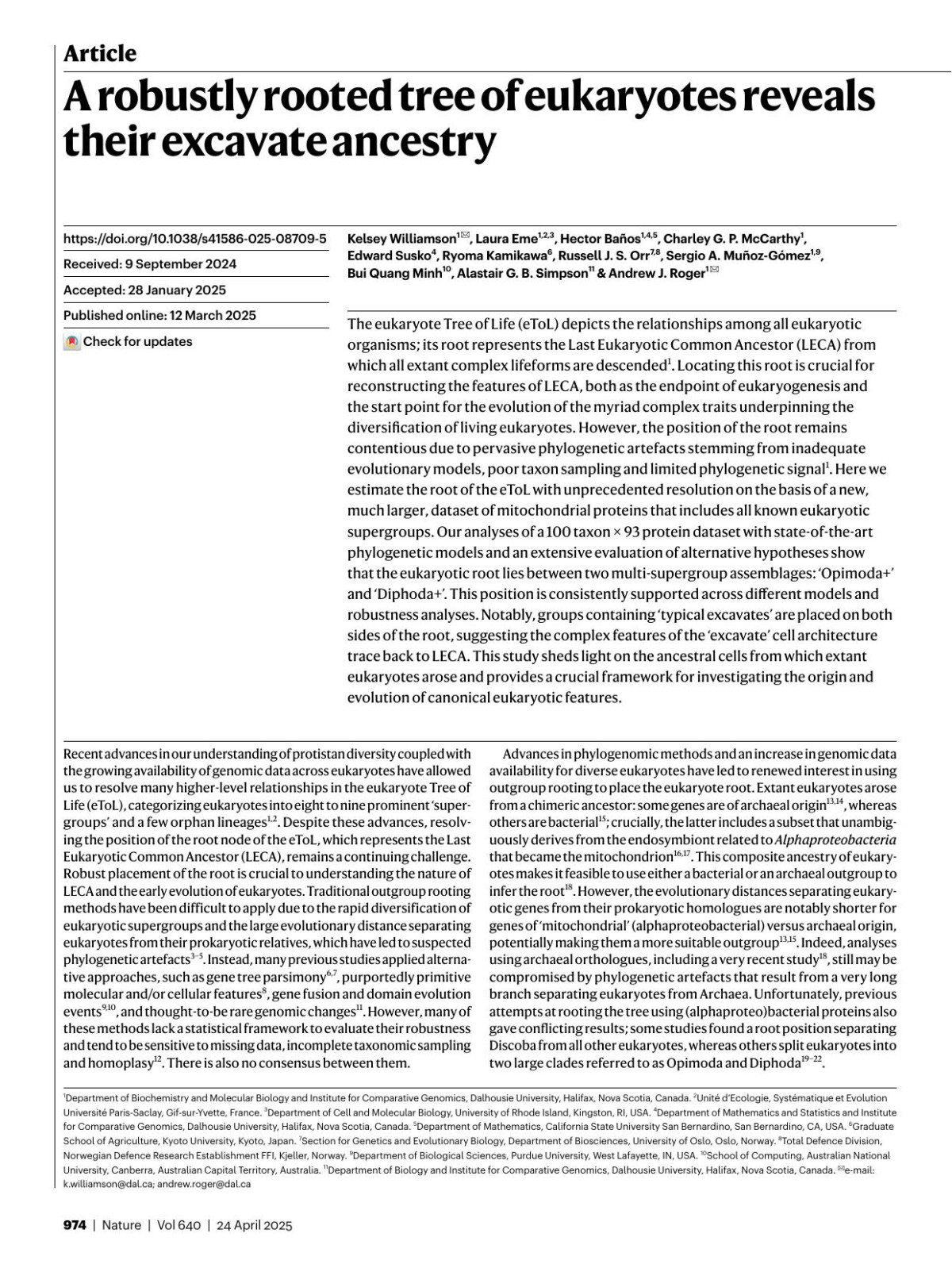
40 reviewsThe eukaryote Tree of Life (eToL) depicts the relationships among all eukaryotic Check for updatesorganisms; its root represents the Last Eukaryotic Common Ancestor (LECA) from which all extant complex lifeforms are descended1. Locating this root is crucial for reconstructing the features of LECA, both as the endpoint of eukaryogenesis and the start point for the evolution of the myriad complex traits underpinning the diversifcation of living eukaryotes. However, the position of the root remains contentious due to pervasive phylogenetic artefacts stemming from inadequate evolutionary models, poor taxon sampling and limited phylogenetic signal1. Here we estimate the root of the eToL with unprecedented resolution on the basis of a new, much larger, dataset of mitochondrial proteins that includes all known eukaryotic supergroups. Our analyses of a 100 taxon × 93 protein dataset with state-of-the-art phylogenetic models and an extensive evaluation of alternative hypotheses show that the eukaryotic root lies between two multi-supergroup assemblages: ‘Opimoda+’ and ‘Diphoda+’. This position is consistently supported across diferent models and robustness analyses. Notably, groups containing ‘typical excavates’ are placed on both sides of the root, suggesting the complex features of the ‘excavate’ cell architecture trace back to LECA. This study sheds light on the ancestral cells from which extant eukaryotes arose and provides a crucial framework for investigating the origin and evolution of canonical eukaryotic features.