Most ebook files are in PDF format, so you can easily read them using various software such as Foxit Reader or directly on the Google Chrome browser.
Some ebook files are released by publishers in other formats such as .awz, .mobi, .epub, .fb2, etc. You may need to install specific software to read these formats on mobile/PC, such as Calibre.
Please read the tutorial at this link: https://ebookbell.com/faq
We offer FREE conversion to the popular formats you request; however, this may take some time. Therefore, right after payment, please email us, and we will try to provide the service as quickly as possible.
For some exceptional file formats or broken links (if any), please refrain from opening any disputes. Instead, email us first, and we will try to assist within a maximum of 6 hours.
EbookBell Team
4.8
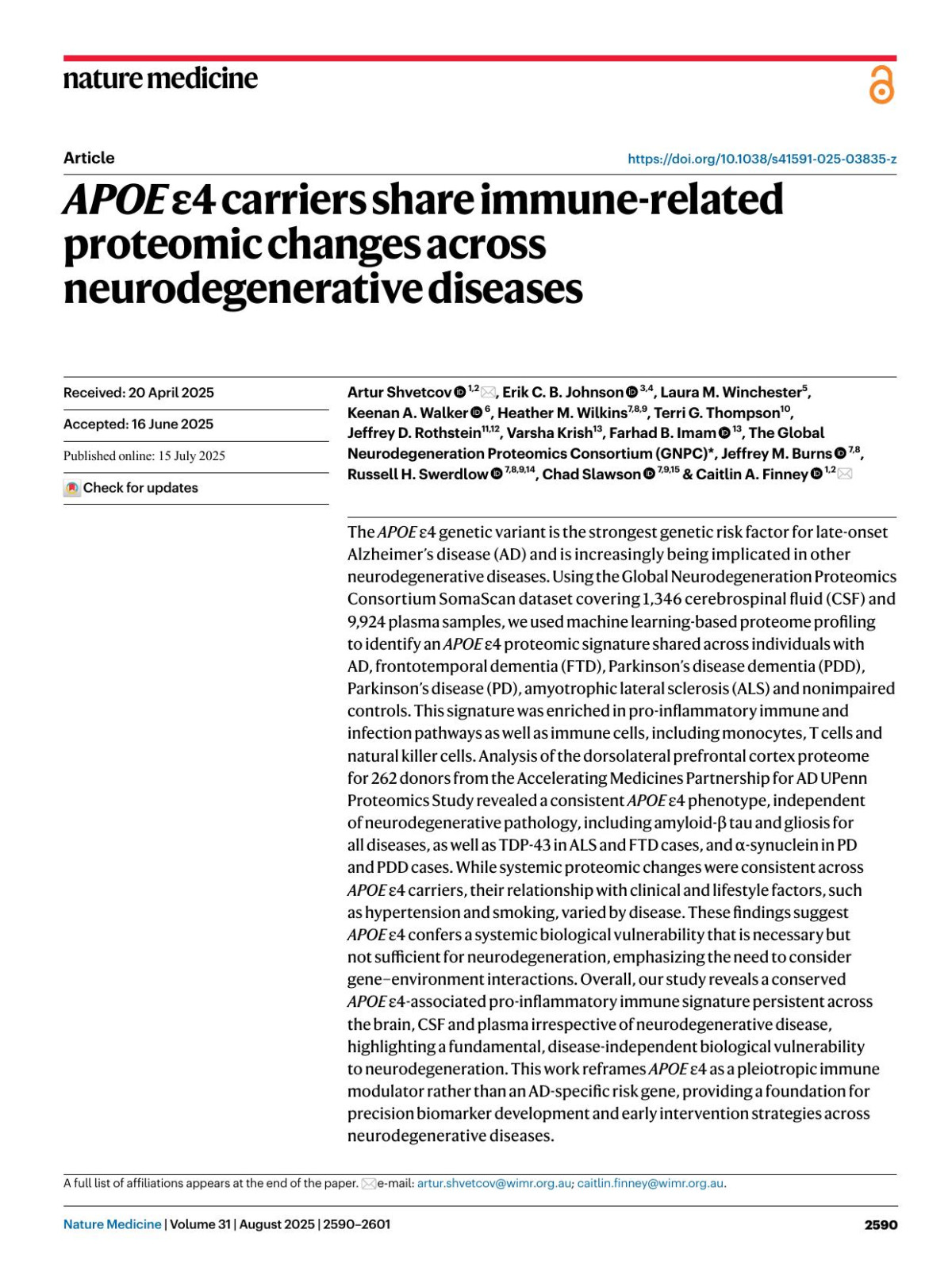
54 reviewsThe APOE ε4 genetic variant is the strongest genetic risk factor for late-onset Alzheimer’s disease (AD) and is increasingly being implicated in other neurodegenerative diseases. Using the Global Neurodegeneration Proteomics Consortium SomaScan dataset covering 1,346 cerebrospinal fuid (CSF) and 9,924 plasma samples, we used machine learning-based proteome profling to identify an APOE ε4 proteomic signature shared across individuals with AD, frontotemporal dementia (FTD), Parkinson’s disease dementia (PDD), Parkinson’s disease (PD), amyotrophic lateral sclerosis (ALS) and nonimpaired controls. This signature was enriched in pro-infammatory immune and infection pathways as well as immune cells, including monocytes, T cells and natural killer cells. Analysis of the dorsolateral prefrontal cortex proteome for 262 donors from the Accelerating Medicines Partnership for AD UPenn Proteomics Study revealed a consistent APOE ε4 phenotype, independent of neurodegenerative pathology, including amyloid-β tau and gliosis for all diseases, as well as TDP-43 in ALS and FTD cases, and α-synuclein in PD and PDD cases. While systemic proteomic changes were consistent across APOE ε4 carriers, their relationship with clinical and lifestyle factors, such as hypertension and smoking, varied by disease. These fndings suggest APOE ε4 confers a systemic biological vulnerability that is necessary but not sufcient for neurodegeneration, emphasizing the need to consider gene–environment interactions. Overall, our study reveals a conserved APOE ε4-associated pro-infammatory immune signature persistent across the brain, CSF and plasma irrespective of neurodegenerative disease, highlighting a fundamental, disease-independent biological vulnerability to neurodegeneration. This work reframes APOE ε4 as a pleiotropic immune modulator rather than an AD-specifc risk gene, providing a foundation for precision biomarker development and early intervention st