Most ebook files are in PDF format, so you can easily read them using various software such as Foxit Reader or directly on the Google Chrome browser.
Some ebook files are released by publishers in other formats such as .awz, .mobi, .epub, .fb2, etc. You may need to install specific software to read these formats on mobile/PC, such as Calibre.
Please read the tutorial at this link: https://ebookbell.com/faq
We offer FREE conversion to the popular formats you request; however, this may take some time. Therefore, right after payment, please email us, and we will try to provide the service as quickly as possible.
For some exceptional file formats or broken links (if any), please refrain from opening any disputes. Instead, email us first, and we will try to assist within a maximum of 6 hours.
EbookBell Team
5.0
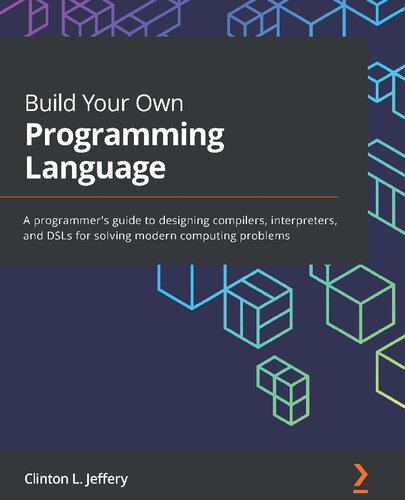
18 reviewsWritten by the creator of the Unicon programming language, this book will show you how to implement programming languages to reduce the time and cost of creating applications for new or specialized areas of computing
Key FeaturesThe need for different types of computer languages is growing rapidly and developers prefer creating domain-specific languages for solving specific application domain problems. Building your own programming language has its advantages. It can be your antidote to the ever-increasing size and complexity of software. However, creating a custom language isn't easy.
In this book, you'll be able to put the knowledge you gain to work in language design and implementation. You'll implement the frontend of a compiler for your language, including a lexical analyzer and parser. The book covers a series of traversals of syntax trees, culminating with code generation for a bytecode virtual machine. Moving ahead, you'll learn how domain-specific language (DSL) features are often best represented by operators and functions that are built into the language, rather than library functions. The book concludes by showing you how to implement garbage collection, including reference counting and mark-and-sweep garbage collection. Throughout the book, Dr. Jeffery weaves in his experience of building the Unicon programming language to give better context to the concepts, while providing relevant examples in Unicon and Java.
By the end of this book, you'll be able to build and deploy your own domain-specific languages, capable of compiling and running programs.
What you will learnThis book is for software developers interested in the idea of inventing their own language or developing a domain-specific language. Computer science students taking compiler construction courses will also find this book highly useful as a practical guide to language implementation to supplement more theoretical textbooks. Intermediate-level knowledge and experience working with a high-level language such as Java or the C++ language are expected to help you get the most out of this book.
Table of Contents