logo

EbookBell.com

Most ebook files are in PDF format, so you can easily read them using various software such as Foxit Reader or directly on the Google Chrome browser.
Some ebook files are released by publishers in other formats such as .awz, .mobi, .epub, .fb2, etc. You may need to install specific software to read these formats on mobile/PC, such as Calibre.

Please read the tutorial at this link:  https://ebookbell.com/faq 


We offer FREE conversion to the popular formats you request; however, this may take some time. Therefore, right after payment, please email us, and we will try to provide the service as quickly as possible.


For some exceptional file formats or broken links (if any), please refrain from opening any disputes. Instead, email us first, and we will try to assist within a maximum of 6 hours.

EbookBell Team
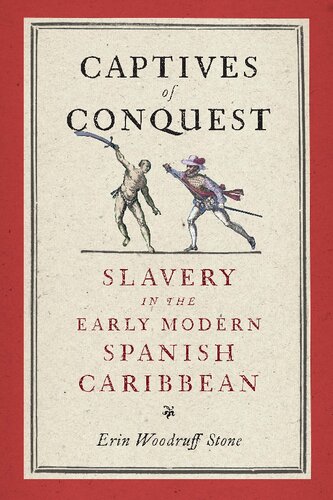
Captives Of Conquest Slavery In The Early Modern Spanish Caribbean Erin Woodruff Stone

  • SKU: BELL-25766934
Captives Of Conquest Slavery In The Early Modern Spanish Caribbean Erin Woodruff Stone
$ 35.00 $ 45.00 (-22%)

4.7

76 reviews

Captives Of Conquest Slavery In The Early Modern Spanish Caribbean Erin Woodruff Stone instant download after payment.

Publisher: University of Pennsylvania Press
File Extension: PDF
File size: 2.8 MB
Pages: 288
Author: Erin Woodruff Stone
ISBN: 9780812253108, 0812253108
Language: English
Year: 2021

Product desciption

Captives Of Conquest Slavery In The Early Modern Spanish Caribbean Erin Woodruff Stone by Erin Woodruff Stone 9780812253108, 0812253108 instant download after payment.

Captives of Conquest is one of the first books to examine the earliest indigenous slave trade in the Spanish Caribbean. Erin Woodruff Stone shows that the indigenous population of the region did not simply collapse from disease or warfare. Rather, upwards of 250,000 people were removed through slavery, a lucrative business sustained over centuries that formed the foundation of economic, legal, and religious policies in the Spanish colonies. The enslavement of and trade in indigenous peoples was central to the processes of conquest, as the search for new sources of Indian slaves propelled much of the early Spanish exploration into Central and South America.
Once captured, some indigenous slaves were shipped to various islands, or as far away as Spain, to be sold for immediate profit. Others became military auxiliaries, guides, miners, pearl divers, servants, or, in the case of women, unwilling sexual partners. In all these roles indigenous slaves helped mold the greater Spanish Caribbean.
Even as the number of African slaves grew in the Americas, enslaved Indians did not disappear. On the contrary, African and Indian slaves worked side by side, the methods and practices of both types of slavery influencing one another throughout the centuries. Together the two forms of slavery helped create the greater Spanish Caribbean, a space and economy founded upon the bondage and coerced labor of both indigenous and African peoples.