logo

EbookBell.com

Most ebook files are in PDF format, so you can easily read them using various software such as Foxit Reader or directly on the Google Chrome browser.
Some ebook files are released by publishers in other formats such as .awz, .mobi, .epub, .fb2, etc. You may need to install specific software to read these formats on mobile/PC, such as Calibre.

Please read the tutorial at this link:  https://ebookbell.com/faq 


We offer FREE conversion to the popular formats you request; however, this may take some time. Therefore, right after payment, please email us, and we will try to provide the service as quickly as possible.


For some exceptional file formats or broken links (if any), please refrain from opening any disputes. Instead, email us first, and we will try to assist within a maximum of 6 hours.

EbookBell Team
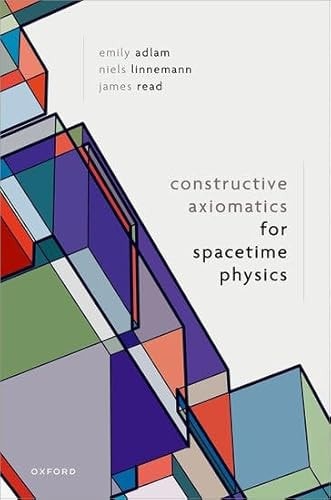
Constructive Axiomatics For Spacetime Physics Emily Adlam Niels Linnemann

  • SKU: BELL-239923538
Constructive Axiomatics For Spacetime Physics Emily Adlam Niels Linnemann
$ 35.00 $ 45.00 (-22%)

5.0

80 reviews

Constructive Axiomatics For Spacetime Physics Emily Adlam Niels Linnemann instant download after payment.

Publisher: x
File Extension: PDF
File size: 6.14 MB
Author: Emily Adlam, Niels Linnemann, James Read
ISBN: 9780198922391, 9780198922377, 0198922396, 019892237X
Language: English
Year: 2025

Product desciption

Constructive Axiomatics For Spacetime Physics Emily Adlam Niels Linnemann by Emily Adlam, Niels Linnemann, James Read 9780198922391, 9780198922377, 0198922396, 019892237X instant download after payment.

The programme of 'constructive axiomatics', promulgated by Hans Reichenbach in 1924, seeks to build up the architecture of our best theories of physics from basic axioms supposedly imbued with immediate and indubitable empirical content. Taking inspiration from Reichenbach, Hermann Weyl proposed his own 'causal-inertial' approach to the constructive axiomatization of Einstein's general relativity, according to which a relativistic spacetime can be constructed solely from the trajectories of light rays and freely-falling particles; this project, however, came to fruition only in 1972, with the constructive axiomatization of general relativity due to Ehlers, Pirani, and Schild ('EPS'). One century since Reichenbach, and fifty years since EPS, Constructive Axiomatics for Spacetime Physics is a celebration of the constructive axiomatic methodology. It achieves four main tasks. First, it provides a thoroughgoing presentation of the EPS axiomatization, closing missing loopholes, identifying problematic axioms, and so forth--in this way, one gains a much-improved appreciation of the extent to which a causal-inertial approach to general relativity might succeed, and of what such an approach might offer. Second, it synthesizes and assesses the vast but disparate literature on constructive axiomatics which has arisen over the past century and sets the methodology in its proper philosophical context. Third, it generalizes the approach to apply to quantum spacetimes. And fourth, it applies the approach to the context of non-relativistic spacetime physics. All in all, the book demonstrates that constructive axiomatics is live-and-kicking; the book will become the go-to resource for this way of philosophizing about the nature of space and time.