Most ebook files are in PDF format, so you can easily read them using various software such as Foxit Reader or directly on the Google Chrome browser.
Some ebook files are released by publishers in other formats such as .awz, .mobi, .epub, .fb2, etc. You may need to install specific software to read these formats on mobile/PC, such as Calibre.
Please read the tutorial at this link: https://ebookbell.com/faq
We offer FREE conversion to the popular formats you request; however, this may take some time. Therefore, right after payment, please email us, and we will try to provide the service as quickly as possible.
For some exceptional file formats or broken links (if any), please refrain from opening any disputes. Instead, email us first, and we will try to assist within a maximum of 6 hours.
EbookBell Team
4.8
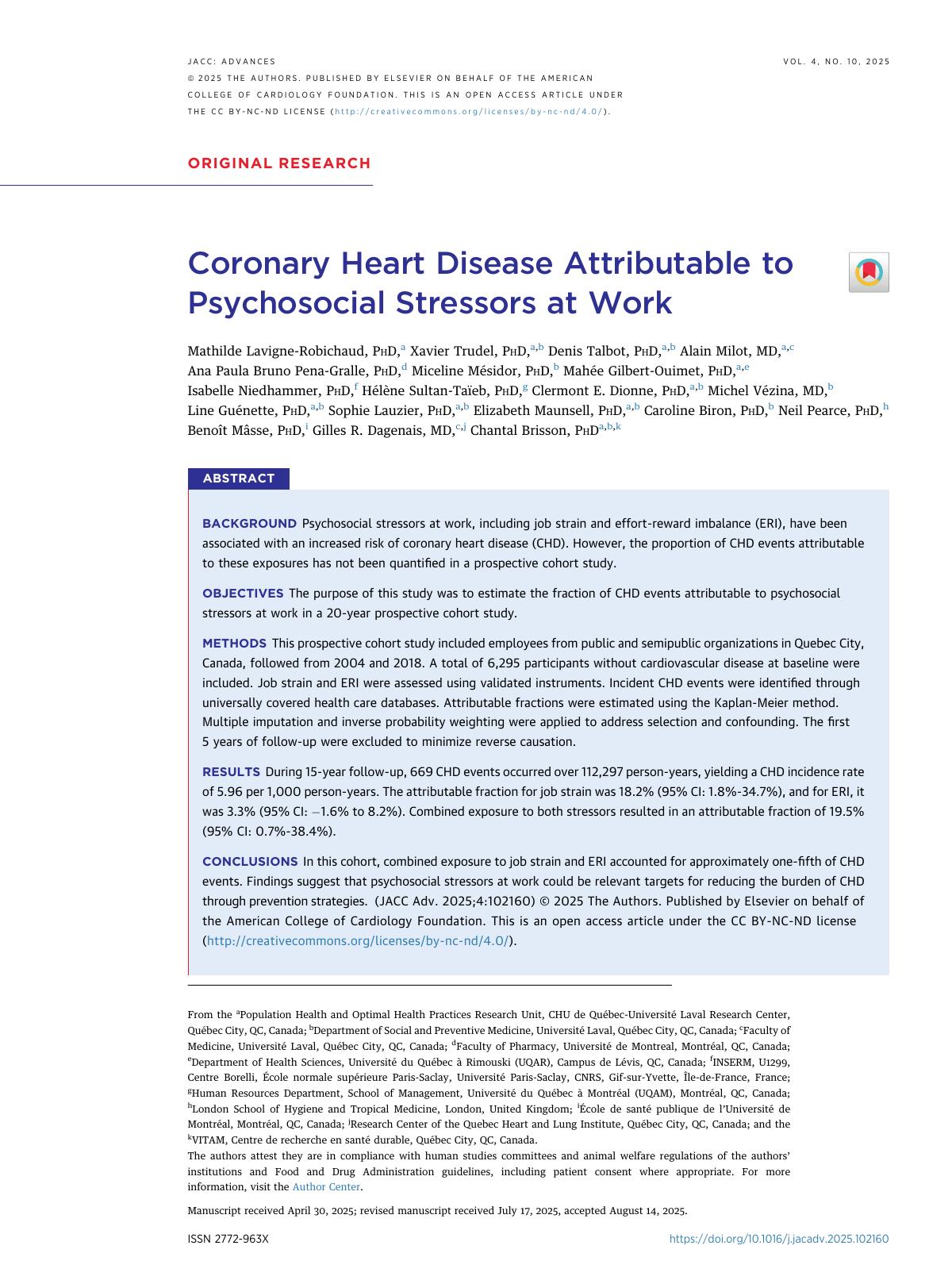
34 reviewsABSTRACTBACKGROUND Psychosocial stressors at work, including job strain and effort-reward imbalance (ERI), have beenassociated with an increased risk of coronary heart disease (CHD). However, the proportion of CHD events attributableto these exposures has not been quantified in a prospective cohort study.OBJECTIVES The purpose of this study was to estimate the fraction of CHD events attributable to psychosocialstressors at work in a 20-year prospective cohort study.METHODS This prospective cohort study included employees from public and semipublic organizations in Quebec City,Canada, followed from 2004 and 2018. A total of 6,295 participants without cardiovascular disease at baseline wereincluded. Job strain and ERI were assessed using validated instruments. Incident CHD events were identified throughuniversally covered health care databases. Attributable fractions were estimated using the Kaplan-Meier method.Multiple imputation and inverse probability weighting were applied to address selection and confounding. The first5 years of follow-up were excluded to minimize reverse causation.RESULTS During 15-year follow-up, 669 CHD events occurred over 112,297 person-years, yielding a CHD incidence rateof 5.96 per 1,000 person-years. The attributable fraction for job strain was 18.2% (95% CI: 1.8%-34.7%), and for ERI, itwas 3.3% (95% CI: − 1.6% to 8.2%). Combined exposure to both stressors resulted in an attributable fraction of 19.5%(95% CI: 0.7%-38.4%).CONCLUSIONS In this cohort, combined exposure to job strain and ERI accounted for approximately one-fifth of CHDevents. Findings suggest that psychosocial stressors at work could be relevant targets for reducing the burden of CHDthrough prevention strategies. (JACC Adv. 2025;4:102160) © 2025 The Authors. Published by Elsevier on behalf ofthe American College of Cardiology Foundation. This is an open access article under the CC BY-NC-ND license(