logo

EbookBell.com

Most ebook files are in PDF format, so you can easily read them using various software such as Foxit Reader or directly on the Google Chrome browser.
Some ebook files are released by publishers in other formats such as .awz, .mobi, .epub, .fb2, etc. You may need to install specific software to read these formats on mobile/PC, such as Calibre.

Please read the tutorial at this link:  https://ebookbell.com/faq 


We offer FREE conversion to the popular formats you request; however, this may take some time. Therefore, right after payment, please email us, and we will try to provide the service as quickly as possible.


For some exceptional file formats or broken links (if any), please refrain from opening any disputes. Instead, email us first, and we will try to assist within a maximum of 6 hours.

EbookBell Team
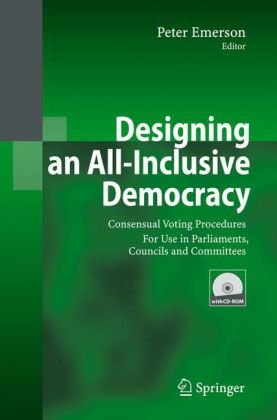
Designing An Allinclusive Democracy Consensual Voting Procedures For Use In Parliaments Councils And Committees 1st Edition Peter Emerson

  • SKU: BELL-2143396
Designing An Allinclusive Democracy Consensual Voting Procedures For Use In Parliaments Councils And Committees 1st Edition Peter Emerson
$ 35.00 $ 45.00 (-22%)

5.0

108 reviews

Designing An Allinclusive Democracy Consensual Voting Procedures For Use In Parliaments Councils And Committees 1st Edition Peter Emerson instant download after payment.

Publisher: Springer
File Extension: PDF
File size: 4.01 MB
Pages: 196
Author: Peter Emerson
ISBN: 9783540331636, 9783540331643
Language: English
Year: 2007
Edition: 1

Product desciption

Designing An Allinclusive Democracy Consensual Voting Procedures For Use In Parliaments Councils And Committees 1st Edition Peter Emerson by Peter Emerson 9783540331636, 9783540331643 instant download after payment.

Democracy is for everybody, not just a majority. This book describes the voting procedures by which majority rule may be replaced by a more consensual system of governance. In a word, such an inclusive polity can be achieved by asking the voters or, more usually, their representatives in councils and parliaments, to state their preferences, so to facilitate the identification of that option which gains the highest average preference score. The first part of the book describes three different voting procedures, the Modified Borda Count, the Quota Borda System and the Matrix Vote, and gives a number of hypothetical examples, all clearly depicted in tables. In the second part, the voting mechanisms are discussed against the background of the theory of voting, social choice theory, human rights and mediation practice. The book includes a foreword by Sir Michael Dummett and contributions by Elizabeth Meehan, Hannu Nurmi and Maurice Salles, among others.

Related Products