Most ebook files are in PDF format, so you can easily read them using various software such as Foxit Reader or directly on the Google Chrome browser.
Some ebook files are released by publishers in other formats such as .awz, .mobi, .epub, .fb2, etc. You may need to install specific software to read these formats on mobile/PC, such as Calibre.
Please read the tutorial at this link: https://ebookbell.com/faq
We offer FREE conversion to the popular formats you request; however, this may take some time. Therefore, right after payment, please email us, and we will try to provide the service as quickly as possible.
For some exceptional file formats or broken links (if any), please refrain from opening any disputes. Instead, email us first, and we will try to assist within a maximum of 6 hours.
EbookBell Team
4.3
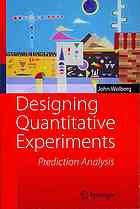
58 reviewsThe method of Prediction Analysis is applicable for anyone interested in designing a quantitative experiment. The design phase of an experiment can be broken down into problem dependent design questions (like the type of equipment to use and the experimental setup) and generic questions (like the number of data points required, range of values for the independent variables and measurement accuracy). This book is directed towards the generic design phase of the process. The
methodology for this phase of the design process is problem independent and can be applied to experiments performed in most branches of science and technology. The purpose of the prediction analysis is to predict the accuracy of the results that one can expect from a proposed experiment. Prediction analyses can be performed using the REGRESS program which was developed by the author and can be obtained free-of-charge through the author's website. Many examples of prediction analyses are included in the book ranging from very simple experiments based upon a linear relationship between the dependent and independent variables to experiments in which the mathematical models are highly non-linear.