logo

EbookBell.com

Most ebook files are in PDF format, so you can easily read them using various software such as Foxit Reader or directly on the Google Chrome browser.
Some ebook files are released by publishers in other formats such as .awz, .mobi, .epub, .fb2, etc. You may need to install specific software to read these formats on mobile/PC, such as Calibre.

Please read the tutorial at this link:  https://ebookbell.com/faq 


We offer FREE conversion to the popular formats you request; however, this may take some time. Therefore, right after payment, please email us, and we will try to provide the service as quickly as possible.


For some exceptional file formats or broken links (if any), please refrain from opening any disputes. Instead, email us first, and we will try to assist within a maximum of 6 hours.

EbookBell Team
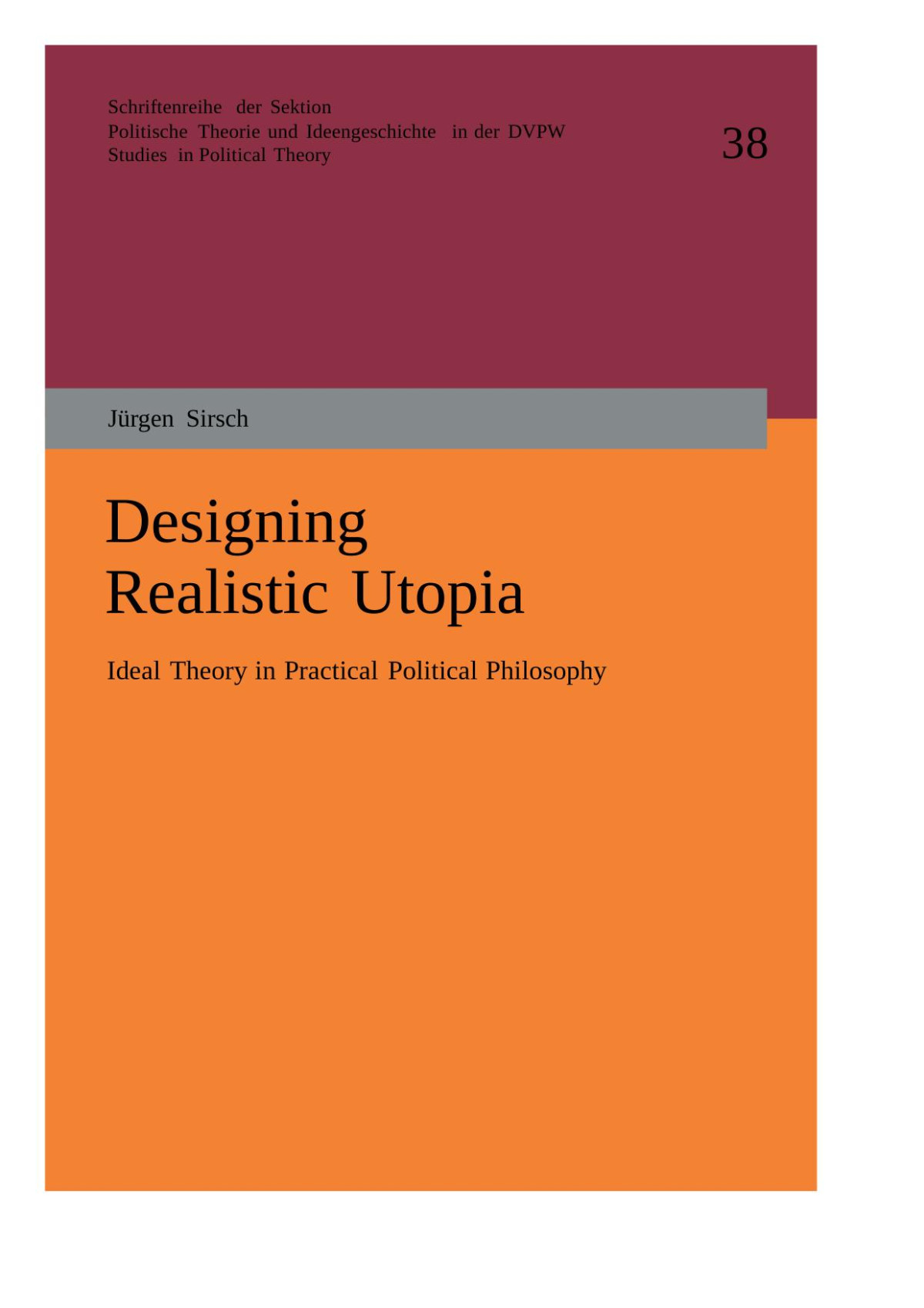
Designing Realistic Utopia Ideal Theory In Practical Political Philosophy 1 Auflage Jürgen Sirsch

  • SKU: BELL-33691410
Designing Realistic Utopia Ideal Theory In Practical Political Philosophy 1 Auflage Jürgen Sirsch
$ 35.00 $ 45.00 (-22%)

4.4

12 reviews

Designing Realistic Utopia Ideal Theory In Practical Political Philosophy 1 Auflage Jürgen Sirsch instant download after payment.

Publisher: Nomos Verlagsges.MBH + Co
File Extension: PDF
File size: 2.66 MB
Pages: 274
Author: Jürgen Sirsch
ISBN: 9783848778027, 3848778025
Language: English
Year: 2020
Edition: 1. Auflage

Product desciption

Designing Realistic Utopia Ideal Theory In Practical Political Philosophy 1 Auflage Jürgen Sirsch by Jürgen Sirsch 9783848778027, 3848778025 instant download after payment.

Building on the work of John Rawls, this book offers a conception of ideal theory which provides practical guidance and a critical perspective on politics, institutions and society. The author develops this approach by discussing recent criticism of ideal theory by authors such as Amartya Sen and Raymond Geuss. Answering Sen’s criticism, the author proposes a novel account of feasibility in relation to ideal theory, especially with regard to ideal institutional design. As a reply to Geuss’ criticism, he discusses constructivist approaches of moral theory-building. Building on this discussion, the book develops an account of practical ideal–theoretical thinking that can be used for evaluating and criticizing societies and can guide institutional design under nonideal conditions.

Related Products