Product desciption
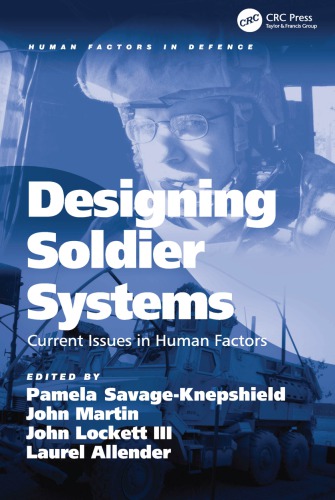
Designing Soldier Systems Current Issues In Human Factors First Edition Allender by Allender, Laurel; Lockett, John; Martin, John; Savage-knepshield, Pamela 9781315576756, 9781317152088, 9781409407775, 1315576759, 1317152085, 1409407772 instant download after payment.
"This book focuses on contemporary human factors issues within the design of soldier systems and describes how they are currently being investigated and addressed by the U.S. Army to enhance soldier performance and effectiveness. Designing Soldier Systems approaches human factors issues from three main perspectives. In the first section, Chapters 1-5 focus on complexity introduced by technology, its impact on human performance, and how issues are being addressed to reduce cognitive workload. In the second section, Chapters 6-10 concentrate on obstacles imposed by operational and environmental conditions on the battlefield and how they are being mitigated through the use of technology. The third section, Chapters 11-21, is dedicated to system design and evaluation including the tools, techniques and technologies used by researchers who design soldier systems to overcome human physical and cognitive performance limitations as well as the obstacles imposed by environmental and operations conditions that are encountered by soldiers. The book will appeal to an international multidisciplinary audience interested in the design and development of systems for military use, including defense contractors, program management offices, human factors engineers, human system integrators, system engineers, and computer scientists. Relevant programs of study include those in human factors, cognitive science, neuroscience, neuroergonomics, psychology, training and education, and engineering."--Provided by publisher.
Abstract: "This book focuses on contemporary human factors issues within the design of soldier systems and describes how they are currently being investigated and addressed by the U.S. Army to enhance soldier performance and effectiveness. Designing Soldier Systems approaches human factors issues from three main perspectives. In the first section, Chapters 1-5 focus on complexity introduced by technology, its impact on human performance, and how issues are being addressed to reduce cognitive workload. In the second section, Chapters 6-10 concentrate on obstacles imposed by operational and environmental conditions on the battlefield and how they are being mitigated through the use of technology. The third section, Chapters 11-21, is dedicated to system design and evaluation including the tools, techniques and technologies used by researchers who design soldier systems to overcome human physical and cognitive performance limitations as well as the obstacles imposed by environmental and operations conditions that are encountered by soldiers. The book will appeal to an international multidisciplinary audience interested in the design and development of systems for military use, including defense contractors, program management offices, human factors engineers, human system integrators, system engineers, and computer scientists. Relevant programs of study include those in human factors, cognitive science, neuroscience, neuroergonomics, psychology, training and education, and engineering."--Provided by publisher