Product desciption
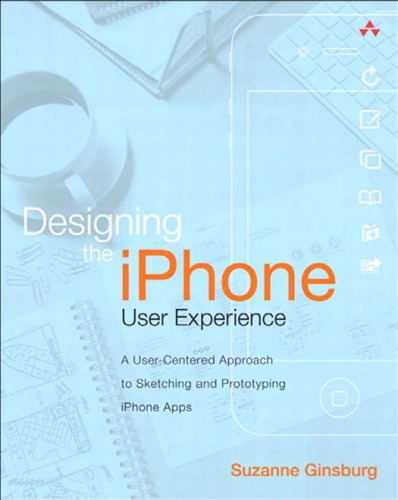
Designing The Iphone User Experience A Usercentered Approach To Sketching And Prototyping Iphone Apps Ginsburg by Ginsburg, Suzanne 9780321699435, 0321699432 instant download after payment.
"In her book "Designing the iPhone User Experience," Suzanne Ginsburg takes a fresh look at cutting-edge, user-centered design from the perspective of designing mobile user experiences for the iPhone. Her book brings together everything you need to know to design great products for mobile contexts."
--Pabini Gabriel-Petit, UX Strategy & Design Consultant and Publisher and Editor in Chief of UXmatters
"It's about time! Suzanne Ginsburg takes the best of User-Centered Design (UCD) principles and tweaks them with a dash of mobile and a lot of hints about what it means to implement the Apple Human Interface Guidelines for iPhone. Your idea for an iPhone app has much better chances of being accepted by iPhone owners (and by the iTunes watchdogs guarding entry to the App Store) if you follow even half of the suggestions in this book."
--Nancy Frishberg, Ph.D., User Experience Strategist and past Chair of BayCHI
Given the fiercely competitive state of the iPhone app landscape, it has become increasingly challenging for app designers and developers to differentiate their apps. The days are long gone when it was possible to crank out an app over the weekend and refine it after receiving a few not so flattering user reviews. Users now have choices -- lots of them. If your app is difficult to use or doesn't meet their needs, finding another one is just a tap away. To illustrate, consider the ever-growing field of Twitter clients. There are hundreds of variations in the App Store but only a handful stand out from the pack (such as Tweetie or Twitterific). For most apps, it boils down to one thing: the user experience. The same is true for countless other categories within the App Store; well-designed apps are more likely to attract and retain users. Of course there are other critical aspects of iPhone app development: the coding, the marketing, the customer support. All of the elements must come together. "Designing the iPhone User Experience" will help you tackle the user experience part of the iPhone challenge. Three key themes will be reinforced throughout the book: Know thy user, the Design Lifecycle, and Attention to Detail: Know Thy User
Millions of people depend on iPhone apps to get them to work, find their next meal, and stay in touch with family and friends. Professionals of all kinds also rely on iPhone apps: doctors look up drug interactions; photographers fine-tune lighting; cyclists find the best routes. To truly understand how your apps can fit into their lives, designers and developers must learn how users do things today, what's important to them, and what needs have not been met. Part II, "Introduction to User Research," will introduce a variety of user research methods. The Design Lifecycle
Award-winning designs rarely happen overnight; they usually only occur after many rigorous design cycles. To illustrate this point, consider USA TODAY's iPhone application, which went through at least seven iterations for the article view in their app. These kinds of iterations should happen before you launch your app, since it will save valuable time and money, not to mention the headaches a bad design could create for your user. More importantly, you may only have one chance to impress your users -- you do not want to sell them half-baked ideas. Part III, "Developing your App Concept," will explain how to iteratively design and test your app concepts. Attention to Detail
Most professionals know that attention to detail is important, but hundreds of apps fail to incorporate even the most basic design principles. This lack of attention is not merely an aesthetic issue (which is important) it also affects the way apps function. For example, a news article without proper alignment will be difficult to read, and a poorly rendered icon will be challenging to interpret. Apps with a razor sharp attention to detail will stand out because their apps will look good and perform well. Part IV, "Refining your App Concept," will show you how to make to your app shine, from visual design and branding to accessibility and localization. Mastering these three areas will help set your app apart from the crowd. You may not have an award-winning app over night. But knowing your users, iterative design, and attention to detail are important first steps.