Most ebook files are in PDF format, so you can easily read them using various software such as Foxit Reader or directly on the Google Chrome browser.
Some ebook files are released by publishers in other formats such as .awz, .mobi, .epub, .fb2, etc. You may need to install specific software to read these formats on mobile/PC, such as Calibre.
Please read the tutorial at this link: https://ebookbell.com/faq
We offer FREE conversion to the popular formats you request; however, this may take some time. Therefore, right after payment, please email us, and we will try to provide the service as quickly as possible.
For some exceptional file formats or broken links (if any), please refrain from opening any disputes. Instead, email us first, and we will try to assist within a maximum of 6 hours.
EbookBell Team
4.0
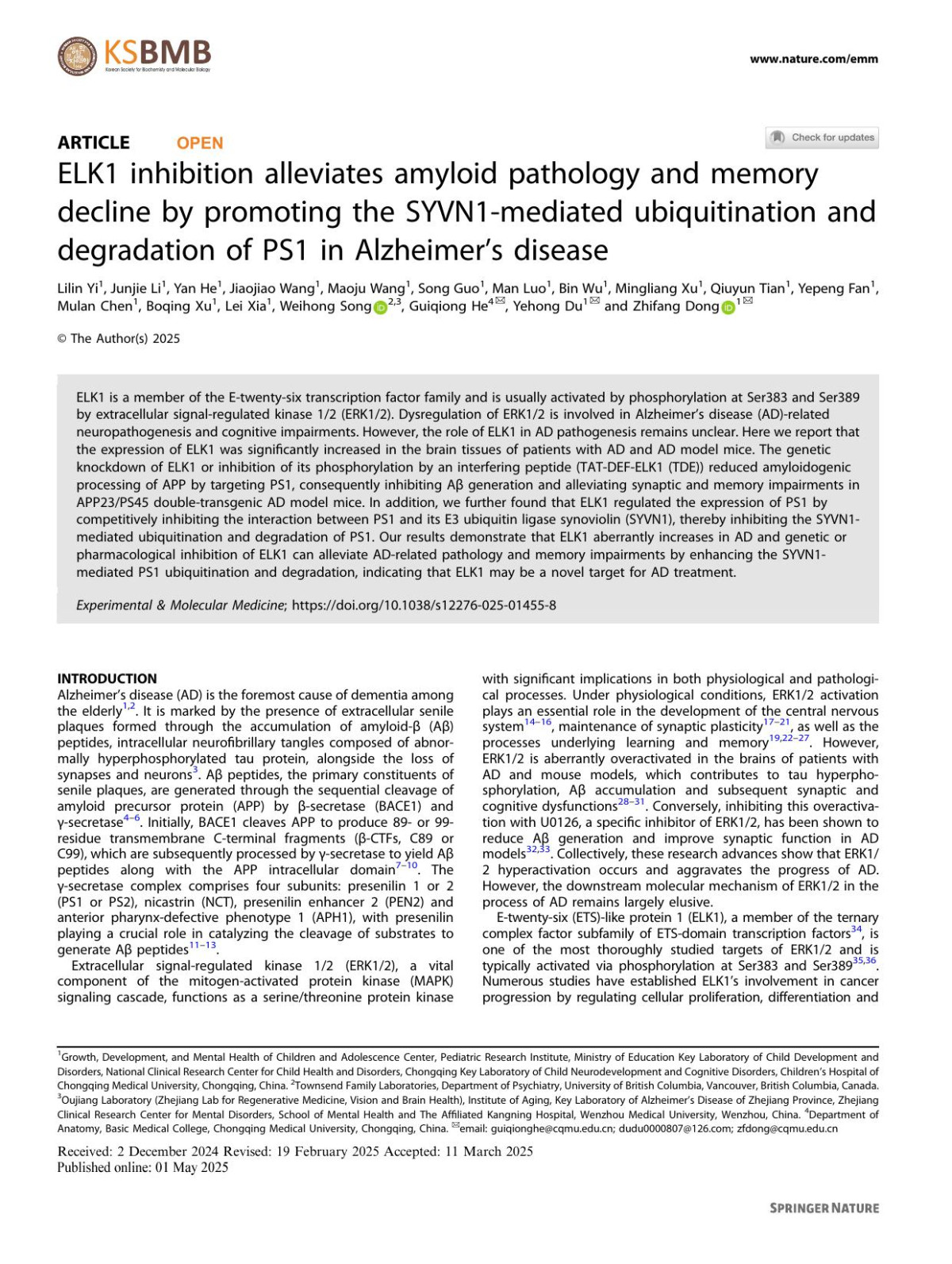
16 reviewsELK1 is a member of the E-twenty-six transcription factor family and is usually activated by phosphorylation at Ser383 and Ser389by extracellular signal-regulated kinase 1/2 (ERK1/2). Dysregulation of ERK1/2 is involved in Alzheimer’s disease (AD)-relatedneuropathogenesis and cognitive impairments. However, the role of ELK1 in AD pathogenesis remains unclear. Here we report thatthe expression of ELK1 was significantly increased in the brain tissues of patients with AD and AD model mice. The geneticknockdown of ELK1 or inhibition of its phosphorylation by an interfering peptide (TAT-DEF-ELK1 (TDE)) reduced amyloidogenic1234567890();,:processing of APP by targeting PS1, consequently inhibiting Aβ generation and alleviating synaptic and memory impairments inAPP23/PS45 double-transgenic AD model mice. In addition, we further found that ELK1 regulated the expression of PS1 bycompetitively inhibiting the interaction between PS1 and its E3 ubiquitin ligase synoviolin (SYVN1), thereby inhibiting the SYVN1-mediated ubiquitination and degradation of PS1. Our results demonstrate that ELK1 aberrantly increases in AD and genetic orpharmacological inhibition of ELK1 can alleviate AD-related pathology and memory impairments by enhancing the SYVN1-mediated PS1 ubiquitination and degradation, indicating that ELK1 may be a novel target for AD treatment.Experimental & Molecular Medicine;