Most ebook files are in PDF format, so you can easily read them using various software such as Foxit Reader or directly on the Google Chrome browser.
Some ebook files are released by publishers in other formats such as .awz, .mobi, .epub, .fb2, etc. You may need to install specific software to read these formats on mobile/PC, such as Calibre.
Please read the tutorial at this link: https://ebookbell.com/faq
We offer FREE conversion to the popular formats you request; however, this may take some time. Therefore, right after payment, please email us, and we will try to provide the service as quickly as possible.
For some exceptional file formats or broken links (if any), please refrain from opening any disputes. Instead, email us first, and we will try to assist within a maximum of 6 hours.
EbookBell Team
0.0
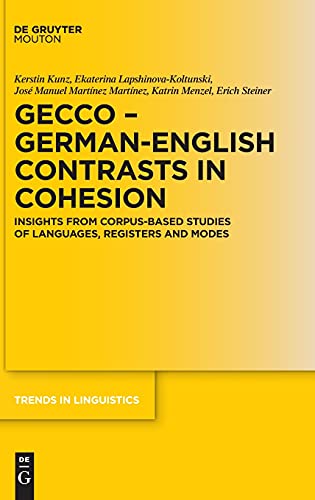
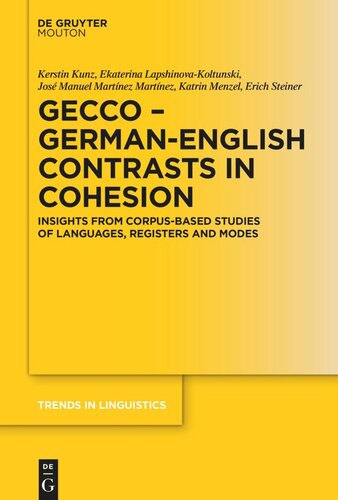
0 reviewsIn contrastive linguistics of English and German, there is a tradition of accounting for contrasts with respect to grammar and, to a lesser extent, for lexis and phonetics. Moving on to discourse and text, there is a sizeable body of literature on cohesive patterns in English and German respectively - but very little in terms of a comparison. The latter, though, is of particular interest for language learners, translators and, of course, linguists and researchers in language technology.
This book attempts to close this gap, based on a number of years of corpus-based study into variation and cohesion in the two languages. While there is an overall focus on language contrasts, it also investigates variation between different registers language-internally, and between written and spoken mode in particular. For each of the five major types of cohesion (co-reference, substitution, ellipsis, conjunctive relations and lexical cohesion), overviews are given of contrasts in the system and of contrastive frequencies in texts.
Results and methods presented in this book are thus relevant for language teaching, translation, language technology and corpus-based work on English and German generally.