Most ebook files are in PDF format, so you can easily read them using various software such as Foxit Reader or directly on the Google Chrome browser.
Some ebook files are released by publishers in other formats such as .awz, .mobi, .epub, .fb2, etc. You may need to install specific software to read these formats on mobile/PC, such as Calibre.
Please read the tutorial at this link: https://ebookbell.com/faq
We offer FREE conversion to the popular formats you request; however, this may take some time. Therefore, right after payment, please email us, and we will try to provide the service as quickly as possible.
For some exceptional file formats or broken links (if any), please refrain from opening any disputes. Instead, email us first, and we will try to assist within a maximum of 6 hours.
EbookBell Team
0.0
0 reviews
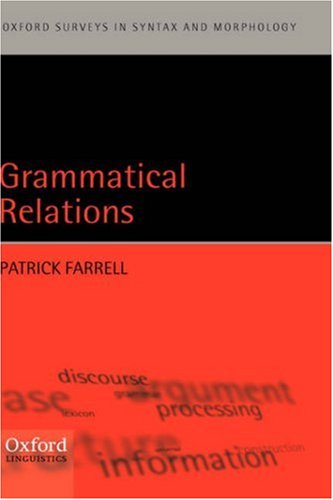
ISBN 13: 9780199264025
Author: Patrick Farrell
Patrick Farrell shows how grammatical relations are characterized in competing theories of grammar and reveals the different theories' merits and limitations. He compares mainstream generative-transformational theory with formalist and functionalist approaches, showing points of convergence and divergence. This is an ideal introduction to the field for graduate students and will be a useful reference for theoretical syntacticians of all persuasions.
1 Introduction
1.1 Different kinds of grammatical relations
1.2 Case, voice, and grammatical relations
1.3 Different theoretical approaches to grammatical relations
1.3.1 Subject and direct object
1.3.2 Indirect object
1.3.3 Oblique and other syntactic functions
1.3.4 Semantic roles
1.4 Theories of grammar
2 Grammatical relations across languages
2.1 Grammatical relations and major typological parameters
2.1.1 Accusative languages
2.1.2 Ergative languages
2.1.3 Split-intransitive languages
2.2 Voice and grammatical-relation alternations
2.2.1 Passive voice
2.2.2 Antipassive voice
2.2.3 Inverse voice
2.2.4 Applicative constructions
2.2.5 The Philippine voice system
2.3 Function splitting and quasi-subjects/objects
2.3.1 Quasi-subjects and oblique subjects
2.3.2 Quasi-objects and oblique objects
3 Relational Grammar
3.1 Basic design of the theory
3.2 Basic language types
3.3 Some case studies
3.3.1 Dative quasi-subjects
3.3.2 Phillipine voice alternations
3.3.3 A/O-reversal in Jarawara
3.3.4 Unaccusativity and the alignment problem
3.3.5 Icelandic dative subjects
3.4 Other relational theories
3.4.1 Lexical-Functional Grammar
3.4.2 Arc Pair Grammar
4 Role and Reference Grammar
4.1 Basic design of the theory
4.1.1 Lexical decomposition and semantic roles
4.1.2 Macroroles
4.1.3 Clause structure and syntactic functions
4.2 Basic language types
4.2.1 Voice constructions across languages
4.2.2 Ergativity, accusativity, and split intransitivity
4.3 Some case studies
4.3.1 Preverbal pronominal slots in Jarawara
4.3.2 Passive and switch reference in Seri
4.3.3 Dative subjects and quasi-subjects
4.3.4 Applicative objects vs. quasi-objects in Indonesian
4.3.5 Quasi-objects in Brazilian Portuguese
4.4 Other functional theories
4.4.1 Functional Grammar
4.4.2 Cognitive Grammar
5 Transformational Grammar
5.1 Basic design of theory
5.1.1 Classical TG
5.1.2 The GB approach
5.1.3 The Minimalist approach
5.2 Typological variation
5.2.1 Ergativity
5.2.2 Split intransitivity
5.3 Some case studies
5.3.1 Multiple subjects and quasi-subject phenomena
5.3.2 Applicative constructions and the indirect object notion
5.4 Related theories
voice and grammatical relations in austronesian languages
types of grammatical relations
the mental representation of grammatical relations pdf
language transfer and universal grammatical relations
marantz on the nature of grammatical relations
grammatical relations and thematic roles
Tags: Patrick Farrell, Grammatical, relations