Most ebook files are in PDF format, so you can easily read them using various software such as Foxit Reader or directly on the Google Chrome browser.
Some ebook files are released by publishers in other formats such as .awz, .mobi, .epub, .fb2, etc. You may need to install specific software to read these formats on mobile/PC, such as Calibre.
Please read the tutorial at this link: https://ebookbell.com/faq
We offer FREE conversion to the popular formats you request; however, this may take some time. Therefore, right after payment, please email us, and we will try to provide the service as quickly as possible.
For some exceptional file formats or broken links (if any), please refrain from opening any disputes. Instead, email us first, and we will try to assist within a maximum of 6 hours.
EbookBell Team
4.4
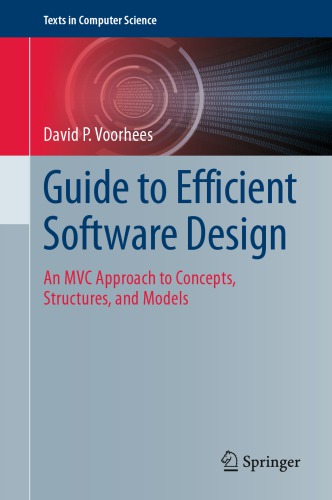
62 reviewsThis classroom-tested textbook presents an active-learning approach to the foundational concepts of software design. These concepts are then applied to a case study, and reinforced through practice exercises, with the option to follow either a structured design or object-oriented design paradigm. The text applies an incremental and iterative software development approach, emphasizing the use of design characteristics and modeling techniques as a way to represent higher levels of design abstraction, and promoting the model-view-controller (MVC) architecture.
Topics and features: provides a case study to illustrate the various concepts discussed throughout the book, offering an in-depth look at the pros and cons of different software designs; includes discussion questions and hands-on exercises that extend the case study and apply the concepts to other problem domains; presents a review of program design fundamentals to reinforce understanding of the basic concepts; focuses on a bottom-up approach to describing software design concepts; introduces the characteristics of a good software design, emphasizing the model-view-controller as an underlying architectural principle; describes software design from both object-oriented and structured perspectives; examines additional topics on human-computer interaction design, quality assurance, secure design, design patterns, and persistent data storage design; discusses design concepts that may be applied to many types of software development projects; suggests a template for a software design document, and offers ideas for further learning.Students of computer science and software engineering will find this textbook to be indispensable for advanced undergraduate courses on programming and software design. Prior background knowledge and experience of programming is required, but familiarity in software design is not assumed.