Most ebook files are in PDF format, so you can easily read them using various software such as Foxit Reader or directly on the Google Chrome browser.
Some ebook files are released by publishers in other formats such as .awz, .mobi, .epub, .fb2, etc. You may need to install specific software to read these formats on mobile/PC, such as Calibre.
Please read the tutorial at this link: https://ebookbell.com/faq
We offer FREE conversion to the popular formats you request; however, this may take some time. Therefore, right after payment, please email us, and we will try to provide the service as quickly as possible.
For some exceptional file formats or broken links (if any), please refrain from opening any disputes. Instead, email us first, and we will try to assist within a maximum of 6 hours.
EbookBell Team
4.7
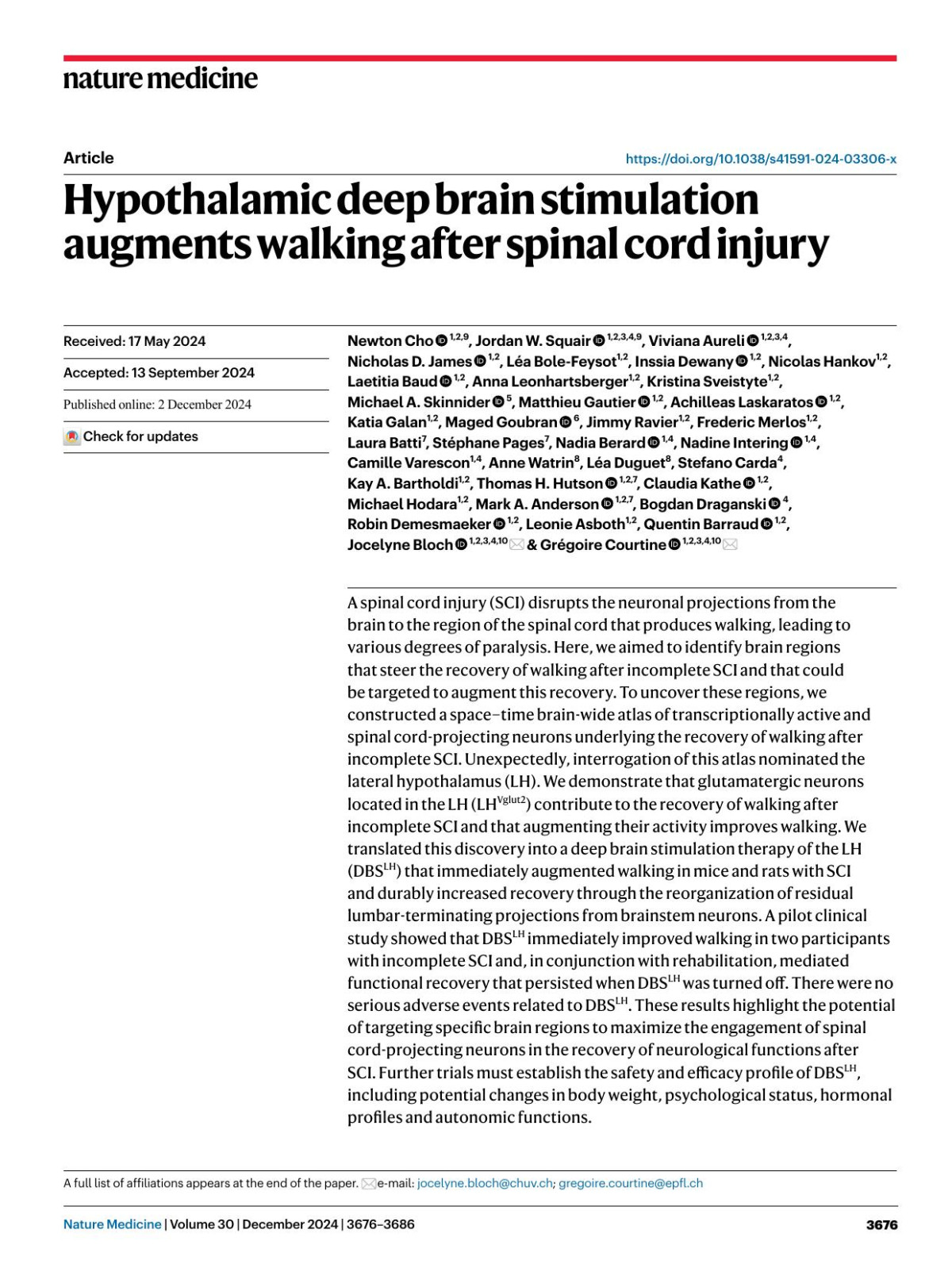
106 reviewsA spinal cord injury (SCI) disrupts the neuronal projections from the brain to the region of the spinal cord that produces walking, leading to various degrees of paralysis. Here, we aimed to identify brain regions that steer the recovery of walking after incomplete SCI and that could be targeted to augment this recovery. To uncover these regions, we constructed a space–time brain-wide atlas of transcriptionally active and spinal cord-projecting neurons underlying the recovery of walking after incomplete SCI. Unexpectedly, interrogation of this atlas nominated the lateral hypothalamus (LH). We demonstrate that glutamatergic neurons located in the LH (LHVglut2) contribute to the recovery of walking after incomplete SCI and that augmenting their activity improves walking. We translated this discovery into a deep brain stimulation therapy of the LH (DBSLH) that immediately augmented walking in mice and rats with SCI and durably increased recovery through the reorganization of residual lumbar-terminating projections from brainstem neurons. A pilot clinical study showed that DBSLH immediately improved walking in two participants with incomplete SCI and, in conjunction with rehabilitation, mediated functional recovery that persisted when DBSLH was turned of. There were no serious adverse events related to DBSLH. These results highlight the potential of targeting specifc brain regions to maximize the engagement of spinal cord-projecting neurons in the recovery of neurological functions after SCI. Further trials must establish the safety and efcacy profle of DBSLH, including potential changes in body weight, psychological status, hormonal profles and autonomic functions.