logo

EbookBell.com

Most ebook files are in PDF format, so you can easily read them using various software such as Foxit Reader or directly on the Google Chrome browser.
Some ebook files are released by publishers in other formats such as .awz, .mobi, .epub, .fb2, etc. You may need to install specific software to read these formats on mobile/PC, such as Calibre.

Please read the tutorial at this link:  https://ebookbell.com/faq 


We offer FREE conversion to the popular formats you request; however, this may take some time. Therefore, right after payment, please email us, and we will try to provide the service as quickly as possible.


For some exceptional file formats or broken links (if any), please refrain from opening any disputes. Instead, email us first, and we will try to assist within a maximum of 6 hours.

EbookBell Team
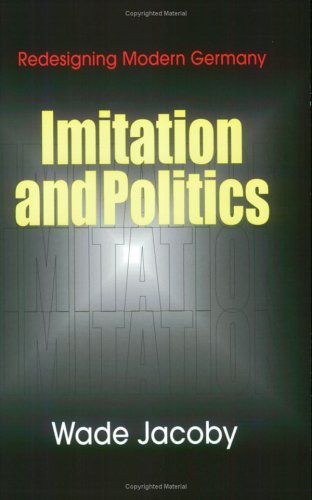
Imitation And Politics Redesigning Modern Germany Illustrated Edition Wade Jacoby

  • SKU: BELL-1851360
Imitation And Politics Redesigning Modern Germany Illustrated Edition Wade Jacoby
$ 35.00 $ 45.00 (-22%)

0.0

0 reviews

Imitation And Politics Redesigning Modern Germany Illustrated Edition Wade Jacoby instant download after payment.

Publisher: Cornell University Press
File Extension: PDF
File size: 26.68 MB
Pages: 240
Author: Wade Jacoby
ISBN: 9780801487699, 0801487692
Language: English
Year: 2001
Edition: illustrated edition

Product desciption

Imitation And Politics Redesigning Modern Germany Illustrated Edition Wade Jacoby by Wade Jacoby 9780801487699, 0801487692 instant download after payment.

Following World War II, a poorly funded, piecemeal effort to transfer British and American institutions into West Germany resulted in many positive changes for that nation's citizens. After reunification, however, a more ambitious, well-funded, and systematic effort to establish West German institutions in the former GDR has been less effective. Through a close analysis of these two cases, Wade Jacoby explores the conditions under which one society can serve as a model for the reshaping of another. In the initial transfer, Jacoby finds, Allied occupying forces sought to build institutions in Germany that were the functional equivalents of ones they valued at home. They encouraged the development of selected German organizations that became co-architects of the postwar society. Several decades later, by contrast, policymakers in Bonn used exact rather than functional imitation, and they ignored regional interests when redesigning East German society. For both cases, Jacoby focuses on attempts to reform industrial relations and secondary education. For innovations to be "pulled in" from abroad, Jacoby argues, local civic groups must participate in and benefit from the institution-building process. In addition, the state imposing the transfer must have a flexible strategy. By looking at international examples, Jacoby provides further evidence that political imitation is at heart a process of coalition building.

Related Products