logo

EbookBell.com

Most ebook files are in PDF format, so you can easily read them using various software such as Foxit Reader or directly on the Google Chrome browser.
Some ebook files are released by publishers in other formats such as .awz, .mobi, .epub, .fb2, etc. You may need to install specific software to read these formats on mobile/PC, such as Calibre.

Please read the tutorial at this link:  https://ebookbell.com/faq 


We offer FREE conversion to the popular formats you request; however, this may take some time. Therefore, right after payment, please email us, and we will try to provide the service as quickly as possible.


For some exceptional file formats or broken links (if any), please refrain from opening any disputes. Instead, email us first, and we will try to assist within a maximum of 6 hours.

EbookBell Team
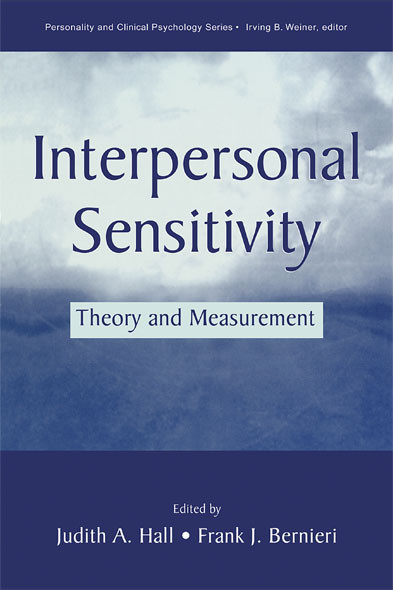
Interpersonal Sensitivity Theory And Measurement Unknown

  • SKU: BELL-237342662
Interpersonal Sensitivity Theory And Measurement Unknown
$ 35.00 $ 45.00 (-22%)

0.0

0 reviews

Interpersonal Sensitivity Theory And Measurement Unknown instant download after payment.

Publisher: LAWRENCE ERLBAUM ASSOCIATES, PUBLISHERS
File Extension: EPUB
File size: 1.62 MB
Author: Unknown
ISBN: 9781135671877, 1135671877
Language: English
Year: 2001

Product desciption

Interpersonal Sensitivity Theory And Measurement Unknown by Unknown 9781135671877, 1135671877 instant download after payment.

Interpersonal sensitivity refers to the accuracy and/or appropriateness of perceptions, judgments, and responses we have with respect to one another. It is relevant to nearly all aspects of social relations and has long been studied by social, personality, and clinical psychologists. Until now, however, no systematic or comprehensive treatment of this complex concept has been attempted. In this volume the major theorists and researchers of interpersonal sensitivity describe their approaches both critically and integratively. Specific tests and methods are presented and evaluated. The authors address issues ranging from the practical to the broadly theoretical and discuss future challenges. Topics include sensitivity to deception, emotion, personality, and other personal characteristics; empathy; the status of self-reports; dyadic interaction procedures; lens model approaches; correlational and categorical measurement approaches; thin-slice and variance partitioning methodologies; and others. This volume offers the single most comprehensive treatment to date of this widely acknowledged but often vaguely operationalized and communicated social competency.