Most ebook files are in PDF format, so you can easily read them using various software such as Foxit Reader or directly on the Google Chrome browser.
Some ebook files are released by publishers in other formats such as .awz, .mobi, .epub, .fb2, etc. You may need to install specific software to read these formats on mobile/PC, such as Calibre.
Please read the tutorial at this link: https://ebookbell.com/faq
We offer FREE conversion to the popular formats you request; however, this may take some time. Therefore, right after payment, please email us, and we will try to provide the service as quickly as possible.
For some exceptional file formats or broken links (if any), please refrain from opening any disputes. Instead, email us first, and we will try to assist within a maximum of 6 hours.
EbookBell Team
4.4
12 reviewsAuthor: Philip Trøst Kristensen
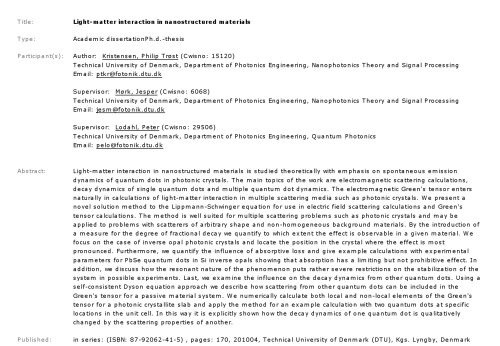
Light-matter interaction in nanostructured materials is studied theoretically with emphasis on spontaneous emission dynamics of quantum dots in photonic crystals. The main topics of the work are electromagnetic scattering calculations, decay dynamics of single quantum dots and multiple quantum dot dynamics. The electromagnetic Green's tensor enters naturally in calculations of light-matter interaction in multiple scattering media such as photonic crystals. We present a novel solution method to the Lippmann-Schwinger equation for use in electric field scattering calculations and Green's tensor calculations. The method is well suited for multiple scattering problems such as photonic crystals and may be applied to problems with scatterers of arbitrary shape and non-homogeneous background materials. By the introduction of a measure for the degree of fractional decay we quantify to which extent the effect is observable in a given material. We focus on the case of inverse opal photonic crystals and locate the position in the crystal where the effect is most pronounced. Furthermore, we quantify the influence of absorptive loss and give example calculations with experimental parameters for PbSe quantum dots in Si inverse opals showing that absorption has a limiting but not prohibitive effect. In addition, we discuss how the resonant nature of the phenomenon puts rather severe restrictions on the stabilization of the system in possible experiments. Last, we examine the influence on the decay dynamics from other quantum dots. Using a self-consistent Dyson equation approach we describe how scattering from other quantum dots can be included in the Green's tensor for a passive material system. We numerically calculate both local and non-local elements of the Green's tensor for a photonic crystallite slab and apply the method for an example calculation with two quantum dots at specific locations in the unit cell. In this way it is explicitly shown how the decay dynamics of one quantum dot is qualitatively changed by the scattering properties of another.
light matter interactions
material light interaction
light-matter interaction
light-matter interactions
light-matter interaction at the nanoscale
Tags: Light matter, interaction, nanostructured materials, Philip Trøst Kristensen