logo

EbookBell.com

Most ebook files are in PDF format, so you can easily read them using various software such as Foxit Reader or directly on the Google Chrome browser.
Some ebook files are released by publishers in other formats such as .awz, .mobi, .epub, .fb2, etc. You may need to install specific software to read these formats on mobile/PC, such as Calibre.

Please read the tutorial at this link:  https://ebookbell.com/faq 


We offer FREE conversion to the popular formats you request; however, this may take some time. Therefore, right after payment, please email us, and we will try to provide the service as quickly as possible.


For some exceptional file formats or broken links (if any), please refrain from opening any disputes. Instead, email us first, and we will try to assist within a maximum of 6 hours.

EbookBell Team
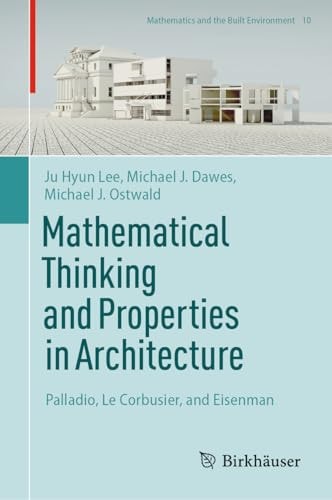
Mathematical Thinking And Properties In Architecture Palladio Le Corbusier And Eisenman 1st Edition Ju Hyun Lee

  • SKU: BELL-236605424
Mathematical Thinking And Properties In Architecture Palladio Le Corbusier And Eisenman 1st Edition Ju Hyun Lee
$ 35.00 $ 45.00 (-22%)

4.0

16 reviews

Mathematical Thinking And Properties In Architecture Palladio Le Corbusier And Eisenman 1st Edition Ju Hyun Lee instant download after payment.

Publisher: Birkhäuser
File Extension: PDF
File size: 5.45 MB
Pages: 228
Author: Ju Hyun Lee, Michael J. Dawes, Michael J. Ostwald
ISBN: 9783031863899, 3031863895
Language: English
Year: 2025
Edition: 1
Volume: 10

Product desciption

Mathematical Thinking And Properties In Architecture Palladio Le Corbusier And Eisenman 1st Edition Ju Hyun Lee by Ju Hyun Lee, Michael J. Dawes, Michael J. Ostwald 9783031863899, 3031863895 instant download after payment.

This monograph explores the profound connections between architecture and mathematics through the works of Andrea Palladio, Le Corbusier, and Peter Eisenman. Combining historical insights with computational analyses, it examines the social, spatial, and aesthetic properties of twenty-six iconic designs. Advanced methods such as Space Syntax, isovists, fractal analysis, image segmentation and semantic linguistic analysis reveal the mathematical principles underlying architectural thinking and properties. Richly illustrated with over 100 visuals, this volume is an essential resource for senior undergraduates, postgraduates, practicing architects, and historians seeking a deeper understanding of mathematical thinking in architectural design and analysis.