Most ebook files are in PDF format, so you can easily read them using various software such as Foxit Reader or directly on the Google Chrome browser.
Some ebook files are released by publishers in other formats such as .awz, .mobi, .epub, .fb2, etc. You may need to install specific software to read these formats on mobile/PC, such as Calibre.
Please read the tutorial at this link: https://ebookbell.com/faq
We offer FREE conversion to the popular formats you request; however, this may take some time. Therefore, right after payment, please email us, and we will try to provide the service as quickly as possible.
For some exceptional file formats or broken links (if any), please refrain from opening any disputes. Instead, email us first, and we will try to assist within a maximum of 6 hours.
EbookBell Team
4.8
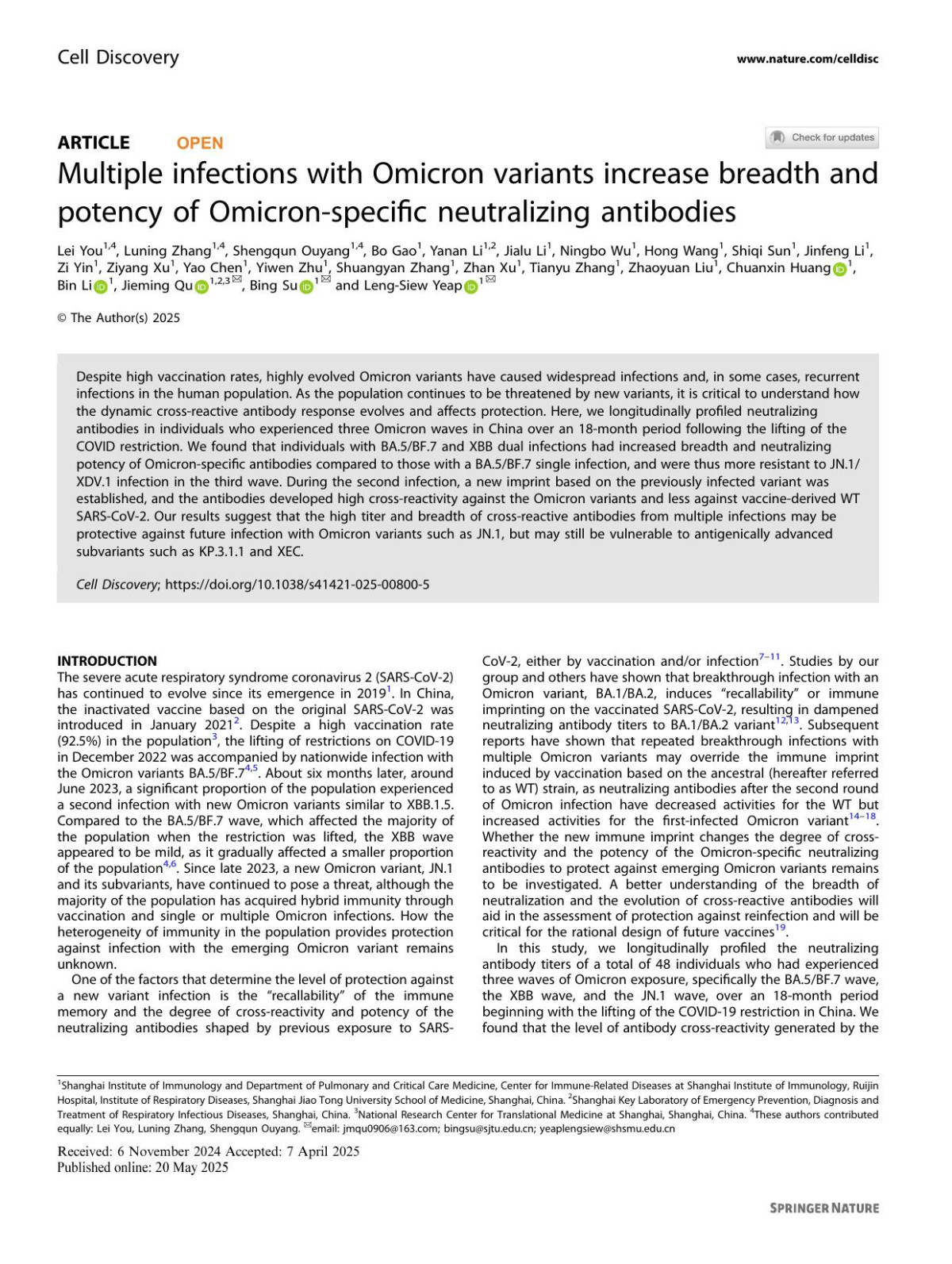
34 reviewsDespite high vaccination rates, highly evolved Omicron variants have caused widespread infections and, in some cases, recurrentinfections in the human population. As the population continues to be threatened by new variants, it is critical to understand howthe dynamic cross-reactive antibody response evolves and affects protection. Here, we longitudinally profiled neutralizingantibodies in individuals who experienced three Omicron waves in China over an 18-month period following the lifting of theCOVID restriction. We found that individuals with BA.5/BF.7 and XBB dual infections had increased breadth and neutralizingpotency of Omicron-specific antibodies compared to those with a BA.5/BF.7 single infection, and were thus more resistant to JN.1/1234567890();,:XDV.1 infection in the third wave. During the second infection, a new imprint based on the previously infected variant wasestablished, and the antibodies developed high cross-reactivity against the Omicron variants and less against vaccine-derived WTSARS-CoV-2. Our results suggest that the high titer and breadth of cross-reactive antibodies from multiple infections may beprotective against future infection with Omicron variants such as JN.1, but may still be vulnerable to antigenically advancedsubvariants such as KP.3.1.1 and XEC.Cell Discovery;