Most ebook files are in PDF format, so you can easily read them using various software such as Foxit Reader or directly on the Google Chrome browser.
Some ebook files are released by publishers in other formats such as .awz, .mobi, .epub, .fb2, etc. You may need to install specific software to read these formats on mobile/PC, such as Calibre.
Please read the tutorial at this link: https://ebookbell.com/faq
We offer FREE conversion to the popular formats you request; however, this may take some time. Therefore, right after payment, please email us, and we will try to provide the service as quickly as possible.
For some exceptional file formats or broken links (if any), please refrain from opening any disputes. Instead, email us first, and we will try to assist within a maximum of 6 hours.
EbookBell Team
4.8
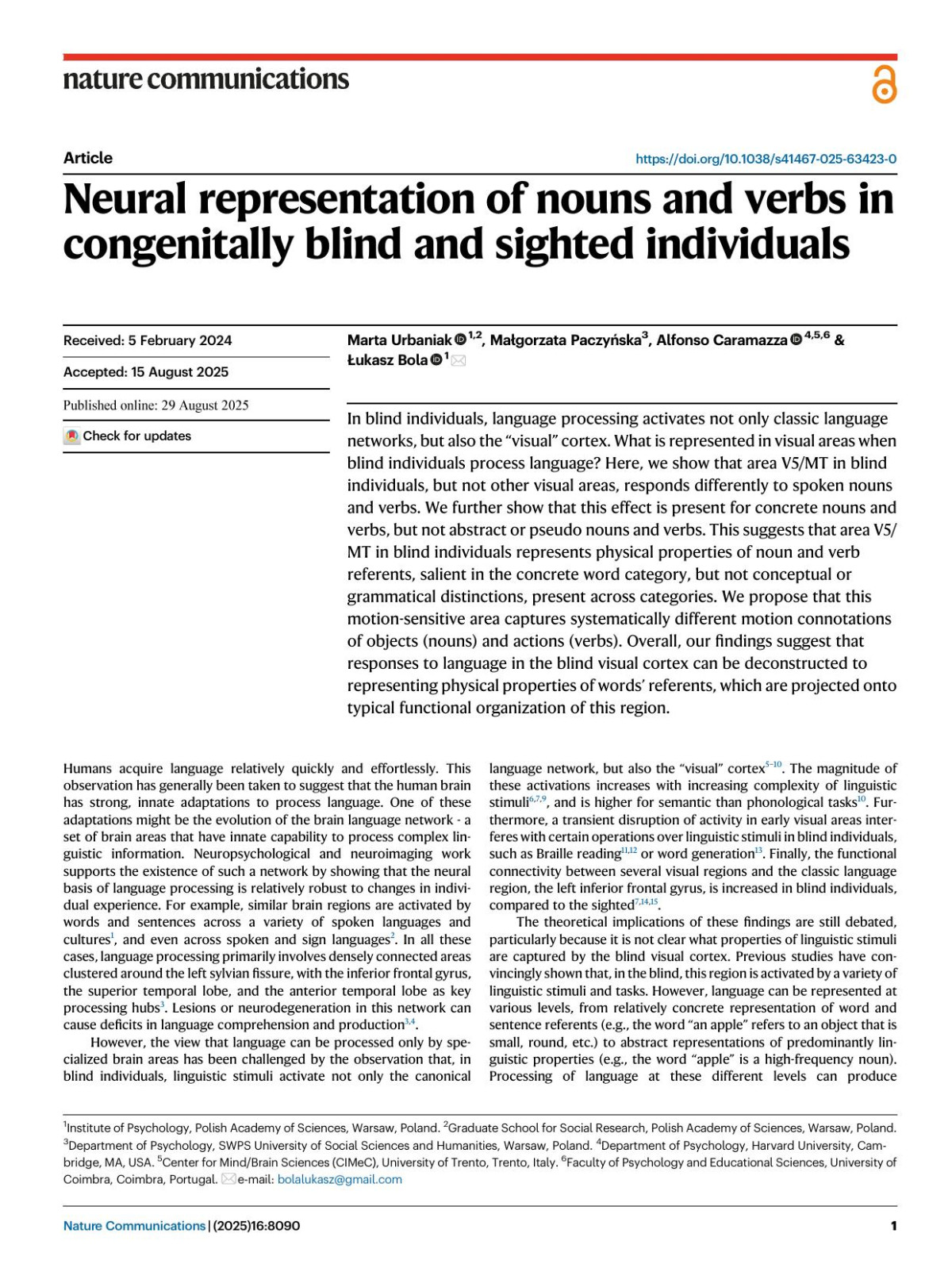
34 reviewsIn blind individuals, language processing activates not only classic language networks, but also the “visual” cortex. What is represented in visual areas when blind individuals process language? Here, we show that area V5/MT in blind individuals, but not other visual areas, responds differently to spoken nouns and verbs. We further show that this effect is present for concrete nouns and verbs, but not abstract or pseudo nouns and verbs. This suggests that area V5/ MT in blind individuals represents physical properties of noun and verb referents, salient in the concrete word category, but not conceptual or grammatical distinctions, present across categories. We propose that this motion-sensitive area captures systematically different motion connotations of objects (nouns) and actions (verbs). Overall, our findings suggest that responses to language in the blind visual cortex can be deconstructed to representing physical properties of words’ referents, which are projected onto typical functional organization of this region.