logo

EbookBell.com

Most ebook files are in PDF format, so you can easily read them using various software such as Foxit Reader or directly on the Google Chrome browser.
Some ebook files are released by publishers in other formats such as .awz, .mobi, .epub, .fb2, etc. You may need to install specific software to read these formats on mobile/PC, such as Calibre.

Please read the tutorial at this link:  https://ebookbell.com/faq 


We offer FREE conversion to the popular formats you request; however, this may take some time. Therefore, right after payment, please email us, and we will try to provide the service as quickly as possible.


For some exceptional file formats or broken links (if any), please refrain from opening any disputes. Instead, email us first, and we will try to assist within a maximum of 6 hours.

EbookBell Team
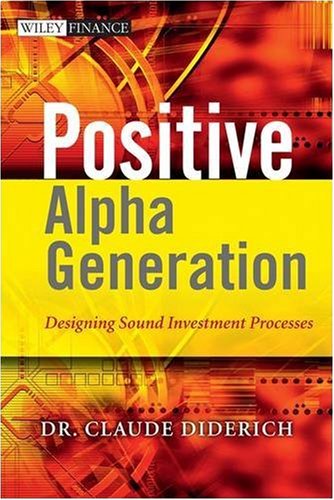
Positive Alpha Generation Designing Sound Investment Processes The Wiley Finance Series Claude Diderich

  • SKU: BELL-1311404
Positive Alpha Generation Designing Sound Investment Processes The Wiley Finance Series Claude Diderich
$ 35.00 $ 45.00 (-22%)

4.0

6 reviews

Positive Alpha Generation Designing Sound Investment Processes The Wiley Finance Series Claude Diderich instant download after payment.

Publisher: Wiley
File Extension: PDF
File size: 2.15 MB
Pages: 369
Author: Claude Diderich
ISBN: 9780470061114, 0470061111
Language: English
Year: 2009

Product desciption

Positive Alpha Generation Designing Sound Investment Processes The Wiley Finance Series Claude Diderich by Claude Diderich 9780470061114, 0470061111 instant download after payment.

Think of this book perhaps as providing a meta-alpha framework. It explains an approach that lets you assess and implement different alpha models. Many risk based models are described. The mathematical treatment is rather advanced. By way of example, you are or should already know at a detailed level the ideas behind CAPM (Capital Asset Pricing Model).One important section talks about portfolio construction algorithms, and how to get total risk from specific and systematic sources.For institutional investors, the book recommends the use of benchmarks. Indeed, it is hard to imagine such an investor not using benchmarks these days. Several sources of benchmarks are proferred.The agency problem is also addressed. Where this distinguishes responsibility for different parts of a portfolio return.

Related Products