Most ebook files are in PDF format, so you can easily read them using various software such as Foxit Reader or directly on the Google Chrome browser.
Some ebook files are released by publishers in other formats such as .awz, .mobi, .epub, .fb2, etc. You may need to install specific software to read these formats on mobile/PC, such as Calibre.
Please read the tutorial at this link: https://ebookbell.com/faq
We offer FREE conversion to the popular formats you request; however, this may take some time. Therefore, right after payment, please email us, and we will try to provide the service as quickly as possible.
For some exceptional file formats or broken links (if any), please refrain from opening any disputes. Instead, email us first, and we will try to assist within a maximum of 6 hours.
EbookBell Team
5.0
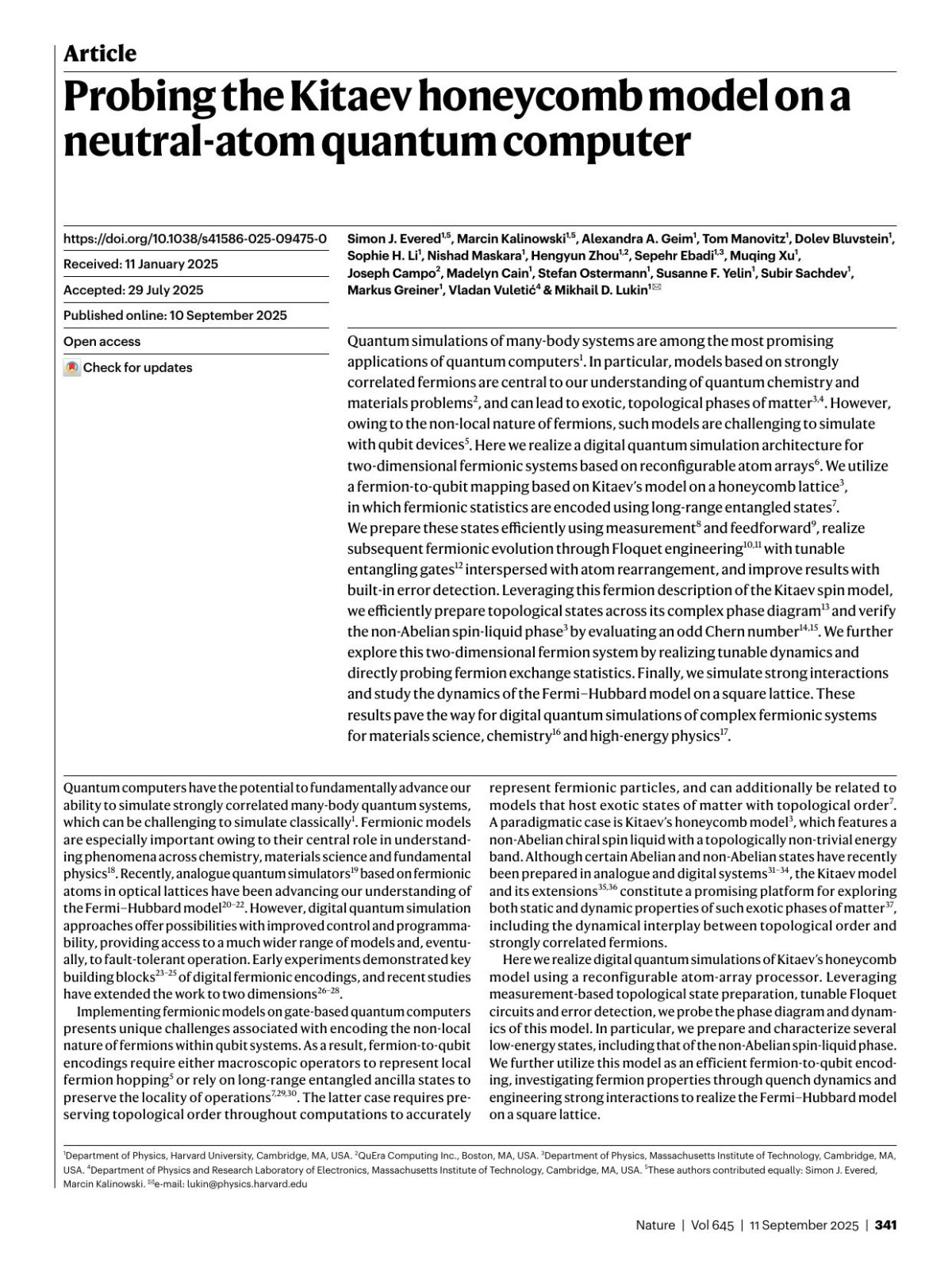
80 reviewsQuantum simulations of many-body systems are among the most promising Check for updatesapplications of quantum computers1. In particular, models based on strongly correlated fermions are central to our understanding of quantum chemistry and materials problems2, and can lead to exotic, topological phases of matter3,4. However, owing to the non-local nature of fermions, such models are challenging to simulate with qubit devices5. Here we realize a digital quantum simulation architecture for two-dimensional fermionic systems based on reconfgurable atom arrays6. We utilize a fermion-to-qubit mapping based on Kitaev’s model on a honeycomb lattice3, in which fermionic statistics are encoded using long-range entangled states7. We prepare these states efciently using measurement8 and feedforward9, realize subsequent fermionic evolution through Floquet engineering10,11 with tunable entangling gates12 interspersed with atom rearrangement, and improve results with built-in error detection. Leveraging this fermion description of the Kitaev spin model, we efciently prepare topological states across its complex phase diagram13 and verify the non-Abelian spin-liquid phase3 by evaluating an odd Chern number14,15. We further explore this two-dimensional fermion system by realizing tunable dynamics and directly probing fermion exchange statistics. Finally, we simulate strong interactions and study the dynamics of the Fermi–Hubbard model on a square lattice. These results pave the way for digital quantum simulations of complex fermionic systems for materials science, chemistry16 and high-energy physics17.