logo

EbookBell.com

Most ebook files are in PDF format, so you can easily read them using various software such as Foxit Reader or directly on the Google Chrome browser.
Some ebook files are released by publishers in other formats such as .awz, .mobi, .epub, .fb2, etc. You may need to install specific software to read these formats on mobile/PC, such as Calibre.

Please read the tutorial at this link:  https://ebookbell.com/faq 


We offer FREE conversion to the popular formats you request; however, this may take some time. Therefore, right after payment, please email us, and we will try to provide the service as quickly as possible.


For some exceptional file formats or broken links (if any), please refrain from opening any disputes. Instead, email us first, and we will try to assist within a maximum of 6 hours.

EbookBell Team
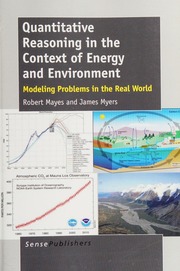
Quantitative Reasoning In The Context Of Energy And Environment Modeling Problems In The Real World Mayes

  • SKU: BELL-238655176
Quantitative Reasoning In The Context Of Energy And Environment Modeling Problems In The Real World Mayes
$ 35.00 $ 45.00 (-22%)

5.0

98 reviews

Quantitative Reasoning In The Context Of Energy And Environment Modeling Problems In The Real World Mayes instant download after payment.

Publisher: Rotterdam : SensePublishers
File Extension: PDF
File size: 21.61 MB
Author: Mayes, Robert, author, Myers, James, author
Language: English
Year: 2014

Product desciption

Quantitative Reasoning In The Context Of Energy And Environment Modeling Problems In The Real World Mayes by Mayes, Robert, Author, Myers, James, Author instant download after payment.

1 online resource (viii, 446 pages), This book provides professional development leaders and teachers with a framework for integrating authentic real-world performance tasks into science, technology, engineering, and mathematics (STEM) classrooms. We incorporate elements of problem-based learning to engage students around grand challenges in energy and environment, place-based leaning to motivate students by relating the problem to their community, and Understanding by Design to ensure that understanding key concepts in STEM is the outcome. Our framework has as a basic tenet interdisciplinary STEM approaches to studying real-world problems. We invited professional learning communities of science and mathematics teachers to bring multiple lenses to the study of these problems, including the sciences of biology, chemistry, earth systems and physics, technology through data collection tools and computational science modeling approaches, engineering design around how to collect data, and mathematics through quantitative reasoning. Our goal was to have teachers create opportunities for their students to engage in real-world problems impacting their place; problems that could be related to STEM grand challenges demonstrating the importance and utility of STEM. We want to broaden the participation of students in STEM, which both increases the future STEM workforce, providing our next generation of scientists, technologists, engineers, and mathematicians, as well as producing a STEM literate citizenry that can make informed decisions about grand challenges that will be facing their generation. While we provide a specifi c example of an interdisciplinary STEM module, we hope to do more than provide a single fish. Rather we hope to teach you how to fish so you can create modules that will excite your students, Print version record, ACKNOWLEDGEMENTS; CHAPTER 1: QUANTITATIVE REASONING: CHANGING PRACTICE IN SCIENCE AND MATHEMATICS: Current State of Practice and New Direction;…