logo

EbookBell.com

Most ebook files are in PDF format, so you can easily read them using various software such as Foxit Reader or directly on the Google Chrome browser.
Some ebook files are released by publishers in other formats such as .awz, .mobi, .epub, .fb2, etc. You may need to install specific software to read these formats on mobile/PC, such as Calibre.

Please read the tutorial at this link:  https://ebookbell.com/faq 


We offer FREE conversion to the popular formats you request; however, this may take some time. Therefore, right after payment, please email us, and we will try to provide the service as quickly as possible.


For some exceptional file formats or broken links (if any), please refrain from opening any disputes. Instead, email us first, and we will try to assist within a maximum of 6 hours.

EbookBell Team
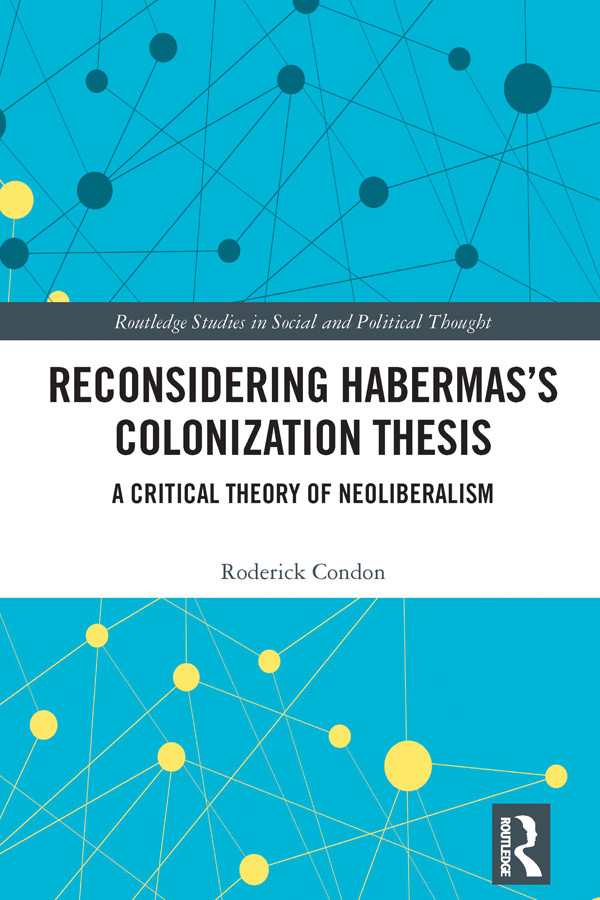
Reconsidering Habermass Colonization Thesis A Critical Theory Of Neoliberalism Roderick Condon

  • SKU: BELL-235138756
Reconsidering Habermass Colonization Thesis A Critical Theory Of Neoliberalism Roderick Condon
$ 35.00 $ 45.00 (-22%)

5.0

88 reviews

Reconsidering Habermass Colonization Thesis A Critical Theory Of Neoliberalism Roderick Condon instant download after payment.

Publisher: Routledge
File Extension: EPUB
File size: 1.08 MB
Author: Roderick Condon
Language: English
Year: 2025

Product desciption

Reconsidering Habermass Colonization Thesis A Critical Theory Of Neoliberalism Roderick Condon by Roderick Condon instant download after payment.

This book reconsiders Habermas’s critique of capitalism as a foundation for a critical theory of neoliberalism. Taking criticisms into account, the author refines and redevelops Habermas’s system-lifeworld paradigm in three parts, focusing on system, lifeworld, and communication. The exposition unfolds through a new synthesis and convergence, from within Habermas’s frame, of Axel Honneth, Niklas Luhmann, Talcott Parsons, and Karl Marx. This synthesis is interwoven with an account of the neoliberal turn, such that social theory is historically contextualized and neoliberalism theoretically explained at one and the same time. The end result is a reconstruction of the colonization thesis in a new theory of relinguistification, advancing a communicative, dialectical, and reflexive theory of reification.
Reconsidering Habermas’s Colonization Thesis will appeal to scholars of critical theory, social theory, sociology, and cultural studies, as well as readers interested in neoliberalism and the critique of capitalism.