Most ebook files are in PDF format, so you can easily read them using various software such as Foxit Reader or directly on the Google Chrome browser.
Some ebook files are released by publishers in other formats such as .awz, .mobi, .epub, .fb2, etc. You may need to install specific software to read these formats on mobile/PC, such as Calibre.
Please read the tutorial at this link: https://ebookbell.com/faq
We offer FREE conversion to the popular formats you request; however, this may take some time. Therefore, right after payment, please email us, and we will try to provide the service as quickly as possible.
For some exceptional file formats or broken links (if any), please refrain from opening any disputes. Instead, email us first, and we will try to assist within a maximum of 6 hours.
EbookBell Team
4.8
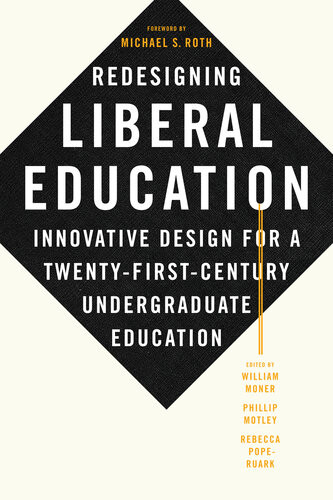
14 reviewsRedesigning liberal education requires both pragmatic approaches to discover what works and radical visions of what is possible.
The future of liberal education in the United States, in its current form, is fraught but full of possibility. Today's institutions are struggling to maintain viability, sustain revenue, and assert value in the face of rising costs. But we should not abandon the model of pragmatic liberal learning that has made America's colleges and universities the envy of the world. Instead, Redesigning Liberal Education argues, we owe it to students to reform liberal education in ways that put broad and measurable student learning as the highest priority.
Written by experts in higher education, the book is organized into two sections. The first section focuses on innovations at 13 institutions: Brown University, College of the Holy Cross, Connecticut College, Elon University, Florida International University, George Mason University, Georgetown University, Lasell College, Northeastern University, Rollins College, Smith College, Susquehanna University, and the University of Wisconsin–Green Bay. Chapters about these institutions consider the vast spectrum of opportunities and challenges currently faced by students, faculty, staff, and administrators, while also offering "radical visions" of the future of liberal education in the United States. Accompanying vision chapters written by some of the foremost leaders in higher education touch on a wide array of subjects and themes, from artificial intelligence and machines to the role that human dispositions, mindsets, resilience, and time play in how we guide students to ideas for bringing playful concepts of creativity and openness into our work.
Ultimately, Redesigning Liberal Education reveals how humanizing forces, including critical thinking, collaboration, cross-cultural competencies, resilience, and empathy, can help drive our world. This uplifting collection is a celebration of the innovative work being done to achieve the promise of a valuable, engaging, and practical undergraduate liberal education.
Isis Artze-Vega, Denise S. Bartell, Randy Bass, John Bodinger de Uriarte, Laurie Ann Britt-Smith, Jacquelyn Dively Brown, Phillip M. Carter, Nancy L. Chick, Michael J. Daley, Maggie Debelius, Janelle Papay Decato, Peter Felten, Ashley Finley, Dennis A. Frey Jr., Chris W. Gallagher, Evan A. Gatti, Lisa Gring-Pemble, Kristína Moss Gudrún Gunnarsdóttir, Anthony Hatcher, Toni Strollo Holbrook, Derek Lackaff, Leo Lambert, Kristin Lange, Sherry Lee Linkon, Anne M. Magro, Maud S. Mandel, Jessica Metzler, Borjana Mikic, William Moner, Phillip Motley, Matthew Pavesich, Uta G. Poiger, Rebecca Pope-Ruark, Michael Reder, Michael S. Roth, Emily Russell, Heather Russell, Ann Schenk, Michael Shanks, Susan Rundell Singer, Andrea A. Sinn, Christina Smith, Allison K. Staudinger, William M. Sullivan, Connie Svabo, Meredith Twombly, Betsy Verhoeven, David J. Voelker, Scott Windham, Mary C. Wright, Catherine Zeek