logo

EbookBell.com

Most ebook files are in PDF format, so you can easily read them using various software such as Foxit Reader or directly on the Google Chrome browser.
Some ebook files are released by publishers in other formats such as .awz, .mobi, .epub, .fb2, etc. You may need to install specific software to read these formats on mobile/PC, such as Calibre.

Please read the tutorial at this link:  https://ebookbell.com/faq 


We offer FREE conversion to the popular formats you request; however, this may take some time. Therefore, right after payment, please email us, and we will try to provide the service as quickly as possible.


For some exceptional file formats or broken links (if any), please refrain from opening any disputes. Instead, email us first, and we will try to assist within a maximum of 6 hours.

EbookBell Team
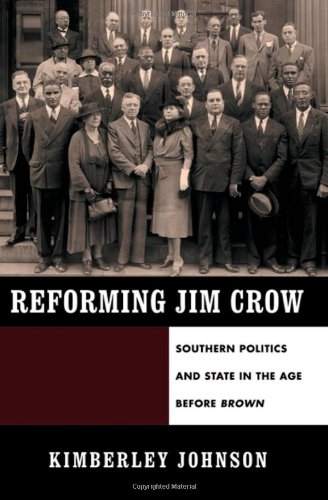
Reforming Jim Crow Kimberley Johnson

  • SKU: BELL-2018306
Reforming Jim Crow Kimberley Johnson
$ 35.00 $ 45.00 (-22%)

4.3

58 reviews

Reforming Jim Crow Kimberley Johnson instant download after payment.

Publisher: Oxford University Press
File Extension: PDF
File size: 1.77 MB
Pages: 336
Author: Kimberley Johnson
ISBN: 9780195387421, 0195387422
Language: English
Year: 2010

Product desciption

Reforming Jim Crow Kimberley Johnson by Kimberley Johnson 9780195387421, 0195387422 instant download after payment.

Historians of the Civil Rights era typically treat the key events of the 1950s Brown v. Board of Education, sit-ins, bus boycotts, and marches--as a revolutionary social upheaval that upended a rigid caste system. While the 1950s was a watershed era in Southern and civil rights history, the tendency has been to paint the preceding Jim Crow era as a brutal system that featured none of the progressive reform impulses so apparent at the federal level and in the North. As Kimberley Johnson shows in this pathbreaking reappraisal of the Jim Crow era, this argument is too simplistic, and is true to neither the 1950s nor the long era of Jim Crow that finally solidified in 1910. Focusing on the political development of the South between 1910 and 1954, Johnson considers the genuine efforts by white and black progressives to reform the system without destroying it. These reformers assumed that the system was there to stay, and therefore felt that they had to work within it in order to modernize the South. Consequently, white progressives tried to install a better--meaning more equitable--separate-but-equal system, and elite black reformers focused on ameliorative (rather than confrontational) solutions that would improve the lives of African Americans. Johnson concentrates on local and state reform efforts throughout the South in areas like schooling, housing, and labor. Many of the reforms made a difference, but they had the ironic impact of generating more demand for social change among blacks. She is able to show how demands slowly rose over time, and how the system laid the seeds of its own destruction. The reformers' commitment to a system that was less unequal--albeit not truly equal--and more like the North led to significant policy changes over time. As Johnson powerfully demonstrates, our lack of knowledge about the cumulative policy transformations resulting from the Jim Crow reform impulse impoverishes our understanding of the Civil Rights revolution. Reforming Jim Crow rectifies that.

Related Products