Most ebook files are in PDF format, so you can easily read them using various software such as Foxit Reader or directly on the Google Chrome browser.
Some ebook files are released by publishers in other formats such as .awz, .mobi, .epub, .fb2, etc. You may need to install specific software to read these formats on mobile/PC, such as Calibre.
Please read the tutorial at this link: https://ebookbell.com/faq
We offer FREE conversion to the popular formats you request; however, this may take some time. Therefore, right after payment, please email us, and we will try to provide the service as quickly as possible.
For some exceptional file formats or broken links (if any), please refrain from opening any disputes. Instead, email us first, and we will try to assist within a maximum of 6 hours.
EbookBell Team
0.0
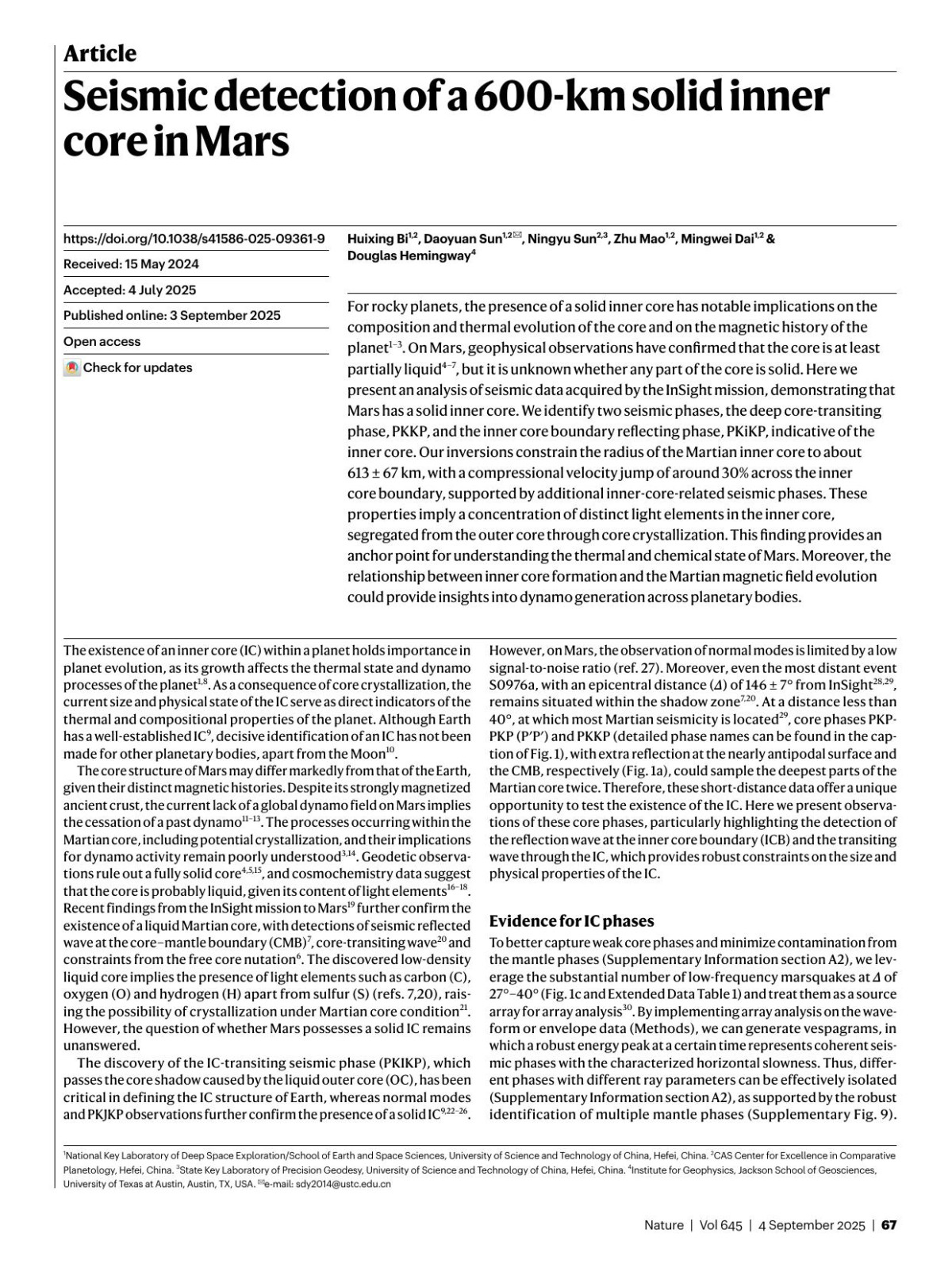
0 reviewsFor rocky planets, the presence of a solid inner core has notable implications on the composition and thermal evolution of the core and on the magnetic history of the planet1,2,3. On Mars, geophysical observations have confirmed that the core is at least partially liquid4,5,6,7, but it is unknown whether any part of the core is solid. Here we present an analysis of seismic data acquired by the InSight mission, demonstrating that Mars has a solid inner core. We identify two seismic phases, the deep core-transiting phase, PKKP, and the inner core boundary reflecting phase, PKiKP, indicative of the inner core. Our inversions constrain the radius of the Martian inner core to about 613 ± 67 km, with a compressional velocity jump of around 30% across the inner core boundary, supported by additional inner-core-related seismic phases. These properties imply a concentration of distinct light elements in the inner core, segregated from the outer core through core crystallization. This finding provides an anchor point for understanding the thermal and chemical state of Mars. Moreover, the relationship between inner core formation and the Martian magnetic field evolution could provide insights into dynamo generation across planetary bodies.