Most ebook files are in PDF format, so you can easily read them using various software such as Foxit Reader or directly on the Google Chrome browser.
Some ebook files are released by publishers in other formats such as .awz, .mobi, .epub, .fb2, etc. You may need to install specific software to read these formats on mobile/PC, such as Calibre.
Please read the tutorial at this link: https://ebookbell.com/faq
We offer FREE conversion to the popular formats you request; however, this may take some time. Therefore, right after payment, please email us, and we will try to provide the service as quickly as possible.
For some exceptional file formats or broken links (if any), please refrain from opening any disputes. Instead, email us first, and we will try to assist within a maximum of 6 hours.
EbookBell Team
4.7
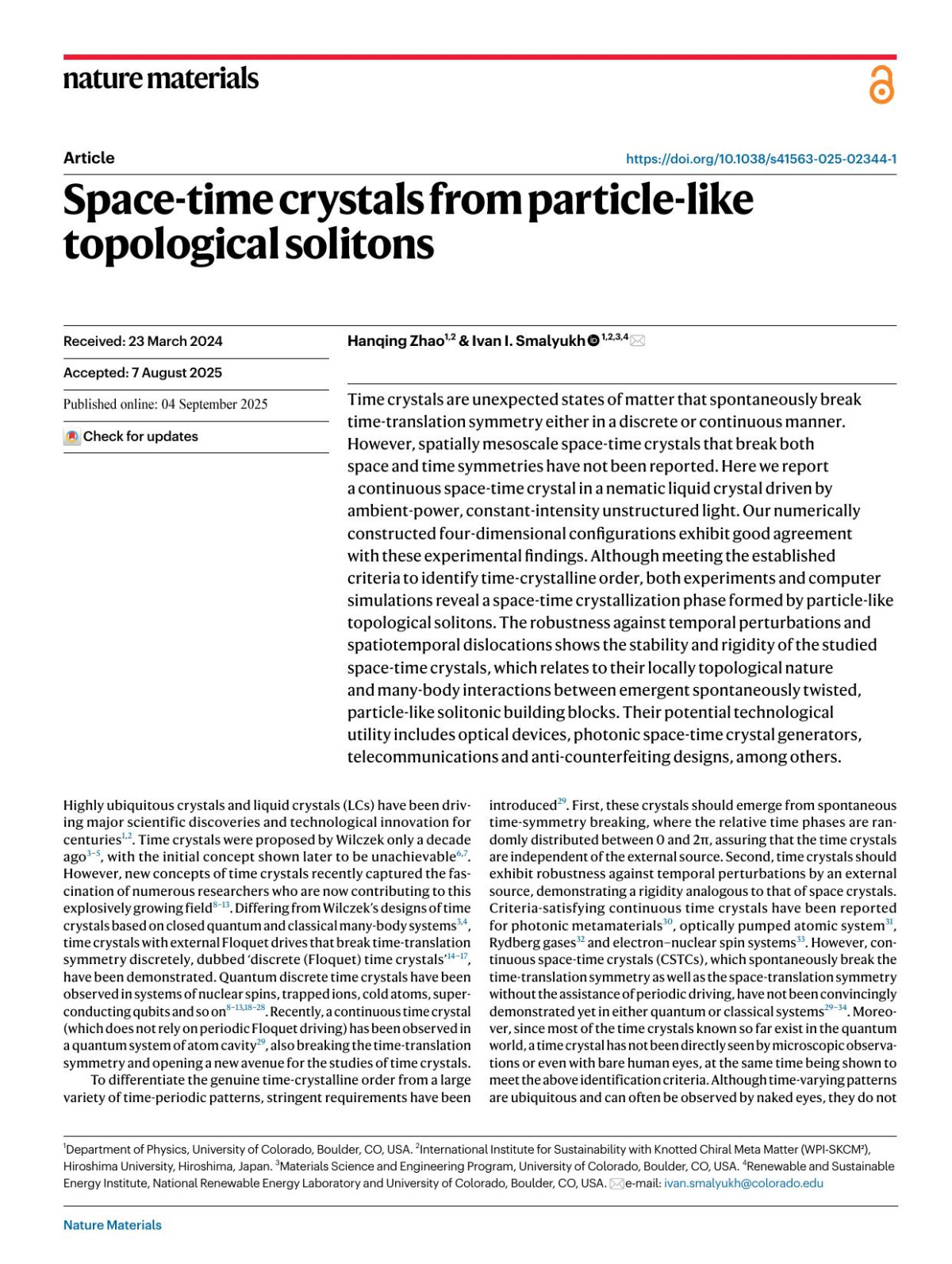
76 reviewsTime crystals are unexpected states of matter that spontaneously break Check for updatestime-translation symmetry either in a discrete or continuous manner. However, spatially mesoscale space-time crystals that break both space and time symmetries have not been reported. Here we report a continuous space-time crystal in a nematic liquid crystal driven by ambient-power, constant-intensity unstructured light. Our numerically constructed four-dimensional confgurations exhibit good agreement with these experimental fndings. Although meeting the established criteria to identify time-crystalline order, both experiments and computer simulations reveal a space-time crystallization phase formed by particle-like topological solitons. The robustness against temporal perturbations and spatiotemporal dislocations shows the stability and rigidity of the studied space-time crystals, which relates to their locally topological nature and many-body interactions between emergent spontaneously twisted, particle-like solitonic building blocks. Their potential technological utility includes optical devices, photonic space-time crystal generators, telecommunications and anti-counterfeiting designs, among others.